Texas-based cybersecurity firm CrowdStrike yesterday blamed a bug in its software for Friday's outage. In analyzing last week's crash, the company outlined its plans to prevent a reoccurrence, including staggering future software updates.
CrowdStrike's update, designed to fix a gap in malware security, was released simultaneously across all devices carrying its Falcon software. A bug in the code, however, caused an estimated 8.5 million Microsoft Windows devices to crash in what was the largest IT outage in history (see explanation here). The blackout led to technology failures across a variety of sectors, including hospital data systems, flights, and more, and costing Fortune 500 companies an estimated $5.4B. The company's CEO has been called to testify before Congress.
Democrats want a massive tax hike on everybody — including you, dear reader — if they can't get an even more massive tax hike on "the rich" and "corporations" when Donald Trump's 2017 tax cuts expire next year.
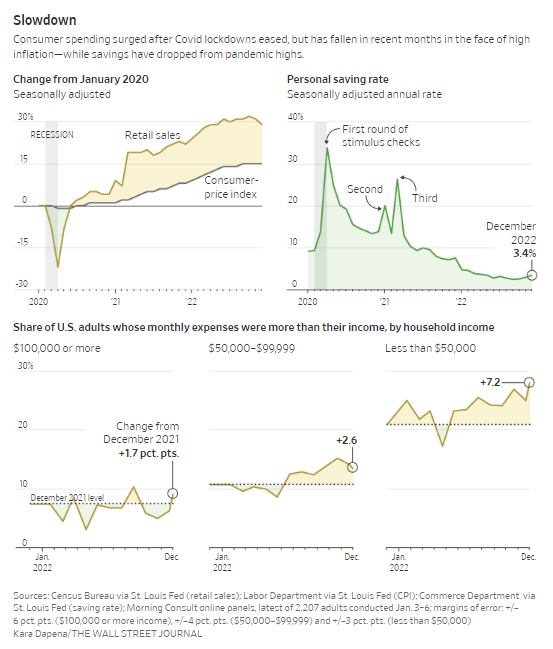
The engine of the U.S. economy—consumer spending—is starting to sputter.
Jazzlyn Millberry in Pickerington, Ohio, has been visiting multiple grocery stores to look for the best deals./ANDREW SPEAR FOR THE WALL STREET JOURNAL
Retail purchases have fallen in three of the past four months. Spending on services, including rent, haircuts and the bulk of bills, was flat in December, after adjusting for inflation, the worst monthly reading in nearly a year. Sales of existing homes in the U.S. fell last year to their lowest level since 2014 as mortgage rates rose. The auto industry posted its worst sales year in more than a decade.
It’s a stark turnaround from the second half of 2020, when Americans lifted the economy out of a pandemic downturn, helping the U.S. avoid what many economists worried would be a prolonged slump. Consumers snapped up exercise bikes, televisions and laptop computers for schoolchildren during lockdowns. When restrictions were lifted, they rushed back to their favorite restaurants and travel destinations.
And they kept spending, helped by government stimulus, flush savings accounts and cheap credit, even as inflation picked up. Faced with four-decade-high inflation last year, Americans outspent it. Through most of 2022, consumer spending growth exceeded price increases by about 2 percentage points.
Now the forces that helped keep spending high are unwinding, while inflation remains elevated. The share of monthly income Americans set aside for savings was 3.4% in December, down from 7.5% a year earlier and from a record high in April 2020. Credit-card interest rates have been rising, and Federal Reserve officials have signaled that they plan an additional quarter-percentage point increase to the central bank’s benchmark rate this week. That would bring the rate to between 4.5% and 4.75%, from near zero at the start of last year.
Annual inflation, as measured by the consumer-price index, remained above 5% in December for the 19th straight month, the longest such streak since the early 1980s.
Consumer spending accounts for roughly 70% of the economy. A downshifting consumer is a key reason that business and academic economists polled by The Wall Street Journal, on average, put the probability of a recession in the next 12 months at 61%. However, many economists say, the U.S. might avoid a recession entirely if spending patterns stabilize.
One factor making forecasting more difficult: While unemployment is trending at a half-century low, big companies including Amazon.com Inc., Goldman Sachs Group Inc., and Microsoft Corp. have begun to cut jobs.
“The last bastion of strength is the labor market, but I don’t think it can withstand all these other forces,” said Nationwide Chief Economist Kathy Bostjancic.
Recent layoff trends worry Benjamin DeLong, a 32-year-old customer-account manager at an industrial manufacturer in southern Minnesota. His savings rose to $3,700 during the pandemic, thanks in part to government stimulus. He is now down to about 3 cents.
Mr. DeLong said he had to dip into his savings to cover the rising costs of his groceries, utilities and car insurance. He has found some relief in his grocery bills since he and his partner decided last year to purchase some pigs, jointly with other families, to be raised on a relative’s farm. Their portion of meat yielded nearly 150 pounds, saving them about $500 on groceries, Mr. DeLong estimated.
The possibility of layoffs, he said, is “part of the crunch that I’m having to consider now. What’s going to happen if I no longer have an income?”
Shoppers in New York./PHOTO: GABBY JONES FOR THE WALL STREET JOURNAL
So far, jobs have remained plentiful and wages continued to rise in the face of Federal Reserve tightening. Unemployment was a low 3.5% in December. Hourly wages were up a robust 4.6% year-over-year. There were about 10.5 million unfilled jobs available in November, according to the Labor Department, a sign that demand for labor remained strong.
“Households had a ton of comfort they don’t normally have about their job prospects,” said Marianne Wanamaker, an economist at the University of Tennessee. “They knew they could get a job tomorrow if they wanted to, and that remains mostly true.”
Still, there are signs of labor-market weakness. Employers are shedding temporary workers at a fast rate, and people who lose their jobs are taking longer to find new ones. Meanwhile, the number of hours worked a week has declined for two straight months, according to the Labor Department, resulting in a slowdown in workers’ take-home pay.
Mikhail Andersson, owner of First Class Tattoo in New York City, has seen signs of weakening demand. After it was cleared to reopen from lockdowns in the summer of 2020, his business was slammed by customers flush with unemployment insurance payments and stimulus checks.
In mid-November of last year, Mr. Andersson started getting calls from clients who had booked daylong tattoo sessions, saying they could only afford shorter ones or pulling out altogether. Mr. Andersson, who specializes in tattoo projects that often take five or six all-day sessions to complete, had 15 cancellations for full-day slots in December.
“In my 15 years doing this, I’ve never seen that—people calling up and saying they don’t have the money to spend right now or can only afford an hour because their current situation is pretty bad,” he said.
For now, First Class Tattoo isn’t likely to slash prices because the baseline level of demand remains strong. Some 250 clients are still on the wait list.
Also weighing on many consumers: The rapid increase in rates in the past year, tied to Fed tightening, has pushed the cost of all types of debt higher.
Mortgage rates reached a 20-year high last fall. Some 57% of consumers were concerned about making housing payments in the fourth quarter, according to a survey by Freddie Mac, up from 48% in the third quarter.
The increases are gradually starting to slow down consumer spending, though it might take a while before the effect is fully realized.
“We’re probably going to have higher interest rates around for quite a while. You would think eventually that would dampen consumption, although that we haven’t had the full effect yet,” said Harvard University economist Kenneth Rogoff.
Credit-card balances were up 15% on the year in the third quarter, according to the Federal Reserve Bank of New York, the largest increase in more than two decades.
Additionally, tens of millions of Americans are set to start or resume making payments on student loans later this year, after the Supreme Court rules on President Biden’s student-debt cancellation plan. Payments have been frozen since March 2020, and are scheduled to begin again 60 days after litigation is resolved or the program is implemented.
Many taxpayers will get smaller refunds when they file their returns in the coming months because Congress didn’t extend the breaks put in place at the height of the pandemic.
Most Americans who lose their jobs can expect unemployment payments for six months or less, at a fraction of their former paychecks, the same as before pandemic programs kicked in. Pandemic programs allowed Americans to receive unemployment payments for as long as 18 months, and in some cases paid workers more than their paychecks.
The previously generous jobless benefits and direct federal payments to households caused the share of income Americans save every month to hit new highs in 2020. Since then, the saving rate has fallen to roughly 3% of monthly income, from more than 30% at the start of lockdowns. In 2019, the year before the pandemic, the rate was 8.8%.
The large stock-market declines over the past year also alarmed consumers, including Scottsdale, Ariz.-based Sara Laor, who is 57 years old. Ms. Laor said the declines depleted the holdings in her 401(k) and IRA accounts by nearly 40%.
Over the past year, her family has had to dip into their savings to pay for essential car and plumbing repairs. They are putting off other expenses, like buying a new car, and have given up ordering in meals.
She’s trying to spend more cautiously, shunning recipes involving pricey eggs and buying more canned food.
“Everything I do just feels like I’m a lot poorer: Can I do this or can I do that?” she said.
U.S. factories, shippers and importers are pulling back, a sign they anticipate less demand from Americans in the months ahead.
Inbound volumes at the ports of Los Angeles and Long Beach in California were down 20.1% in December from a year earlier, and have been behind 2019 levels since August. A little over a year ago, backlogs at ports were drawing President Biden’s attention.
Nicholas Hobbs, chief operating officer of J.B. Hunt Transport Services Inc., which manages truck and rail shipments, said the company has seen demand fall off for big and bulky products, including appliances, furniture and exercise equipment—although off-price retailers with discounted inventory are shipping more.
Jazzlyn Millberry, 33, has been looking for big ways to make cuts. One day last fall, her banking app informed her that the cost of one month’s groceries and household goods for her family of four had risen to $900, from about $600 or $700.
“I find myself now going to three or four different grocery stores just to get the best deals on things to save on costs,” said Ms. Millberry, a health-insurance claims analyst in Pickerington, Ohio.
On one recent outing, she stopped at Kroger for eggs and meat, Aldi for produce, Sam’s Club for her children’s snacks, and Target for toilet paper.
Even as she has cut back on groceries, restaurants, hairstyling and facials, her credit-card balances have grown in the past several months. She said she started making only the minimum required payment on her credit cards.
Gwynn Guilford and Paul Page contributed to this article.
When natural gas prices surged last year after Russia invaded Ukraine, so did prices for fertilizer, which manufacturers such as Yara produce with ammonia and nitrogen obtained as a byproduct from natural gas. Fertilizer prices had already begun increasing in 2021 due to high energy costs and supply-chain issues.
Declining natural gas prices and weak demand among farmers have eased pressures somewhat over the past few months. Earlier this month, fertilizer prices fell to their lowest level in nearly two years in tandem with natural gas prices. But despite falling prices, Holsether insists that the global fertilizer market is precarious, and countries should shift from relying on Russian natural gas, to safeguard their agricultural industries.
“Putin has weaponized energy and they’re weaponizing food as well,” Holsether told the BBC at last week’s World Economic Forum in Davos, Switzerland. “It’s the saying, ‘Fool me once, shame on you. Fool me twice, shame on me.’”
Fertilizer prices remain high by historical standards, and the World Bank warned earlier this month that global supply is still tight due to the war, production cuts in Europe, and stricter export controls in China.
Trade is great. But putting US workers in competition with Third World wages hasn’t been great for them or for domestic manufacturing. And depending on potentially hostile and/or unstable regimes for vital inputs is just stupid.
Markets: Stocks crumbled like a Nutri-Grain bar following a hotter-than-expected inflation report, because it all but confirms a massive interest rate hike by the Fed next week. As is typical when investors get spooked by looming rate hikes, tech got whacked the hardest: Every single stock in the Nasdaq 100 fell yesterday—the first time that’s happened since March 2020.
The August inflation report was more disappointing than NFL kickers on Sunday, teeing up another gigantic interest rate hike from the Fed next week.
Consumer prices in August increased 0.1% from the previous month and 8.3% compared to a year ago—more than anticipated. Economists had expected inflation to continue its downward trend from July, when prices didn’t increase at all, but apparently we can’t have nice things.
So what happened?
The popular theory was that plummeting fuel prices would push costs down across the economy. And gas prices have plummeted—they fell 10.6% in August, and as of Tuesday they’ve dropped for 91 consecutive days. Some of you may have even glimpsed a $2 figure when filling up.
But the deflationary fumes wafting from gas stations have not spread to other sectors. Core CPI, which removes volatile food and gas prices, jumped 0.6% last month, driven by price increases in rents, new cars, medical care, and other areas. Food prices also spiked in August.
The Fed is on deck
August’s hot inflation data bolsters the central bank’s plan to hike rates by 0.75 percentage point at its meeting next week. While that may seem like a tiny number, it will spur a considerable increase in borrowing costs for individuals and businesses. (Remember, the European Central Bank had never hiked rates by 0.75% until it did last week.)
But Fed Chair Jerome Powell, whose job description is to get inflation to 2%, sees no other option than to continue jacking up three-pointers. In his much-hyped Jackson Hole speech last month, Powell said that even though sustained interest rate increases will bring “some pain” to Americans, letting inflation rip for longer would be even worse. Due to inflation’s stubbornness, the chances of Powell bringing the pain likely increased yesterday.—NF
Markets: US stock markets were closed yesterday so investors could spend an extra day at their beach houses, but OPEC still managed to keep energy traders glued to their phones. The oil producing alliance and its partners (a group known as OPEC+) made the surprise decision to cut production targets by about 100,000 barrels per day come October. They aren’t happy that crude prices have been dropping, but consumers might be, since US gas prices may soon fall below $3, analysts say.
The great Rush Limbaugh used to say that “the modern environmentalists worship the created, not the creator.” I was reminded of that after listening to House Speaker Nancy Pelosi once President Joe Biden signed the fiscally unconscionable $750 billion tax-and-spend Inflation Reduction Act, which gives another $300 billion to the climate change-industrial complex.
Pelosi (D-CA) claimed the wind, solar, and electric subsidies in the Inflation Reduction Act would placate an “angry” planet. “Mother Earth gets angry from time to time, and this legislation will help us address all of that,” the speaker said.
This is a highly revealing statement. Do Pelosi and her Democratic colleagues really believe that spending $300 billion on Tesla subsidies (with batteries made in China), windmills (made in China), and solar panels (made in China) is going to save the planet, stop the rise of the oceans, and lower the global temperature?
This is the same gang in Congress that can’t stop the daily drive-by shootings in our cities, can’t secure the U.S.-Mexico border, can’t come anywhere near balancing the budget, and can’t provide the resources our military needs for our national security.
Even if this additional $300 billion were to work as planned, the Wall Street Journal reports that the impact on global temperatures in the coming decades would be to lower them by 0.001%. So, instead of the global temperature being an average of 59 degrees Fahrenheit, it will be 58.999 degrees. Thank God! We are saved from Armageddon.
But as Pelosi’s quote makes clear, this is about symbolism. It is about ruining the economy as a sacrifice to Mother Earth. Marc Morano, the journalist who runs the Climate Depot website, asks: “Will human sacrifices be next to appease the ‘angry’ Earth gods? Actually, this bill will create human sacrifice by imposing even more suffering from energy deprivation, supply chain issues, good shortages, inflation, debt, and bad science.”
As Tom Wolfe wrote in his epochal 1976 article, “The ‘Me’ Decade and the Third Great Awakening:” “It is entirely possible that in the long run historians will regard the entire New Left experience as not so much a political as a religious episode wrapped in semi military gear and guerrilla talk.” (That line was written with early ‘70s radical chic in mind, but reverberates quite nicely today, given Antifa’s current love of paramilitary cosplay.)
Markets: Investors head into the new month with surprisingly positive vibes—particularly in the battered tech sector. The Nasdaq’s 12.3% gain last month was its best since April 2020, and Amazon’s July was its best month in 13 years.
Markets: A Friday surge was too little too late for the stock market, which posted yet another losing week. A heavy slate of earnings should be the main market-moving force in the days ahead.