Showing posts with label Environmentalism. Show all posts

Wednesday, August 16, 2023

CO2 Capture is HAZARDOUS to your health WHO Cares?

 CO2 Capture is HAZARDOUS to your health WHO Cares?)

Inbox

Chris Hansen cuinohio67@gmail.com

Fri, Jun 9, 11:56 AM
to me

Past ruptures - questions why  Oil pipelines get all the press

Tuesday, November 15, 2022

A Theology (Not Ideology) of Creation Care


Vol. 18, No. 90

A Theology (Not Ideology) of Creation Care
Photo by Akil Mazumder (Pexels)
We have been charged to care for God’s creation. To be stewards of all that God has made and entrusted to us. Since the Industrial Revolution, we have been able to do more care for creation than ever before, as well as more harm.
 
That harm has ramifications that border on the nightmarish, and no one is more affected than the poorest of the poor. No matter what you may think is behind it all – natural causes, human causes, or both – that creation is suffering in unprecedented ways is without dispute.
 
Extreme heat.
Drought.
Mudslides.
The rise of intense storms and hurricanes.
Melting of glaciers.
Rising animal extinctions.
Rising plant extinctions.
The freakish amount and scope of wildfires.
 
This should matter to any follower of Christ.
 
UNICEF just released a report that by 2050, virtually every child on the planet – more than 2 billion children – will experience frequent heat waves as part of their life. Pediatricians say that young children and infants are more susceptible to heat-related illnesses, in part because their bodies cannot regulate temperature as effectively as adults. Children also lose fluid more quickly and are at a greater risk of heat stroke because they lack the judgment and maturity needed to taper their physical exertion or know to rehydrate. Extreme heat is also known to trigger symptoms in people with asthma, which affects about 6 million children in the U.S. alone.
 
So why aren’t more Christians engaged?
 
It’s because we have approached creation care ideologically instead of theologically.
 
Politicization has invaded our thinking to such a degree that when it comes to environmental concerns and challenges, responsibilities and commitments, we think about our political moorings before we look to what the Bible actually says. Or more to the point, instead of what the Bible actually says. We carry our political views like they are religious views, and we often make those political views our true religion.
 
As Sandra Richter observes in her book Stewards of Eden,
“... in the United States, if you are an environmentalist, it is assumed that you are a Democrat.... If you are a Republican, it is assumed that you cannot also be pro-environment. In other words, somehow environmental advocacy has been pigeonholed into a particular political profile and has become guilty by association.” 
She then adds these words: “But of course, Christians are first the citizens of heaven, and therefore our alliances and our value systems are not defined by American politics.”
 
So how do we think Christianly about creation care? What would a beginning theology entail?
 
The first and most foundational thing to understand about creation is that it doesn’t belong to us. It isn’t ours to simply do with as we please. It belongs to God. As we read in the 24th psalm, “The earth is the Lord’s, and everything in it. The world and all its people belong to him” (Psalm 24:1, NLT). You find that very same declaration made throughout Scripture (e.g., Psalm 50:10-11, Colossians 1:15-16).
 
Second, we have been charged to care for creation. The nature of that stewardship, as outlined in Genesis 1 and 2, is very clear: we are to reflect the image of God toward creation through governing and reigning, tending and watching over. This is dominion, not domination. The directive was truly creation care. As Dorothy Boorse writes in Loving the Least of These: Addressing a Changing Environment: “We don’t worship creation. We worship God by caring for creation.”
 
Third, this charge didn’t end with the Garden of Eden and the fall of humanity into sin and the world into brokenness. Just as God seeks to redeem us from our sin, and those of us who have been redeemed seek to share that redemptive work with others, God intends to redeem all of creation, and thus we are to continue to take our care of creation seriously. As Paul wrote,
“Against its will, all creation was subjected to God’s curse. But with eager hope, the creation looks forward to the day when it will join God’s children in glorious freedom from death and decay. For we know that all creation has been groaning as in the pains of childbirth right up to the present time.” (Romans 8:20-22, NLT)
Finally, a theology of creation care extends that care in a holistic manner to the land and plants (Ex. 23:10-11; Lev. 25:4-5), both domestic and wild animals (Gen. 9:8-11, Ex. 23:12, Deut. 5:14-15, 22:6-7, 25:4), eco-systems (Job 39:5-8, Ps. 104:10-12, 16-18) and environment (Deut. 20:19-20). Many of the laws given to the people of Israel were fulfilled in Christ and not meant to be specifically applied today (e.g., dietary laws). But what is present in each and every one of the environmental directives is the heart of God in the matter. It was uniformly related to the care and ongoing sustainability of creation.
 
So here is the foundational theology behind creation care:
  1. Creation belongs to God.
  2. We have been charged, as Image bearers, to care for creation.
  3. Creation is included in God’s redemptive plan.
  4. That care involves responsible stewardship.
But theology is meant to be applied. Here’s how Wendell Berry, in his book What Are People For, made the application:
“The ecological teaching of the Bible is simply inescapable: God made the world because He wanted it made. He thinks the world is good, and He loves it. It is His world; He has never relinquished title to it. And He has never revoked the conditions, bearing on His gift to us of the use of it, that oblige us to take excellent care of it. If God loves the world, then how might any person of faith be excused for not loving it or justified in destroying it.”
Yes. 
 
And I pray to God that the people of God would begin applying it before it is too late.
        
James Emery White


Sources
 
Kelly Kasulis Cho, “‘Virtually Every Child’ to Face Frequent Heat Waves By 2050, UNICEF Says,” The Washington Post, October 26, 2022, read online.
 
Sandra L. Richter, Stewards of Eden: What Scripture Says About the Environment and Why It Matters (InterVarsity Press, 2020), p. 2.
 
“Loving the Least of These: Addressing a Changing Environment,” published by the National Association of Evangelicals, Revised Edition (2022), p. 16.
 
Wendell Berry, What Are People For? (New York: North Point, 1990), p. 98.

Sunday, August 21, 2022

Is modern environmentalism a pagan religion?

 YES. NEXT QUESTION?


 Is modern environmentalism a pagan religion?

The great Rush Limbaugh used to say that “the modern environmentalists worship the created, not the creator.” I was reminded of that after listening to House Speaker Nancy Pelosi once President Joe Biden signed the fiscally unconscionable $750 billion tax-and-spend Inflation Reduction Act, which gives another $300 billion to the climate change-industrial complex.

Pelosi (D-CA) claimed the wind, solar, and electric subsidies in the Inflation Reduction Act would placate an “angry” planet. “Mother Earth gets angry from time to time, and this legislation will help us address all of that,” the speaker said.

This is a highly revealing statement. Do Pelosi and her Democratic colleagues really believe that spending $300 billion on Tesla subsidies (with batteries made in China), windmills (made in China), and solar panels (made in China) is going to save the planet, stop the rise of the oceans, and lower the global temperature?

This is the same gang in Congress that can’t stop the daily drive-by shootings in our cities, can’t secure the U.S.-Mexico border, can’t come anywhere near balancing the budget, and can’t provide the resources our military needs for our national security.

Even if this additional $300 billion were to work as planned, the Wall Street Journal reports that the impact on global temperatures in the coming decades would be to lower them by 0.001%. So, instead of the global temperature being an average of 59 degrees Fahrenheit, it will be 58.999 degrees. Thank God! We are saved from Armageddon.

But as Pelosi’s quote makes clear, this is about symbolism. It is about ruining the economy as a sacrifice to Mother Earth. Marc Morano, the journalist who runs the Climate Depot website, asks: “Will human sacrifices be next to appease the ‘angry’ Earth gods? Actually, this bill will create human sacrifice by imposing even more suffering from energy deprivation, supply chain issues, good shortages, inflation, debt, and bad science.”

As Tom Wolfe wrote in his epochal 1976 article, “The ‘Me’ Decade and the Third Great Awakening:” “It is entirely possible that in the long run historians will regard the entire New Left experience as not so much a political as a religious episode wrapped in semi military gear and guerrilla talk.” (That line was written with early ‘70s radical chic in mind, but reverberates quite nicely today, given Antifa’s current love of paramilitary cosplay.)

#H

Monday, April 26, 2021

THE GREEN NEW DEAL WILL IMPOVERISH AMERICA


THE GREEN NEW DEAL WILL IMPOVERISH AMERICA


‘The interesting thing about the Green New Deal is it wasn’t originally a climate thing at all… Do you guys think of it as a climate thing? Because we really think of it as a how-do-you-change-the-entire-economy thing.’ So said Saikat Chakrabarti, former chief of staff for Alexandria Ocasio-Cortez, and generally acknowledged author of the Green New Deal.

Sometimes it is wise to find out what ideas’ originators actually think. That is true for documents that have lit up our lives, such as the US Constitution, as well as for those that have darkened them, such as Mein Kampf.

This is true as well for the nascent Green New Deal, which President Joe Biden has essentially adopted as his own. Even if Congress fails to pass it entirely, Biden will seek to impose many of its goals through administrative diktats on gas-powered cars, land use, airplanes, any form of fossil fuel and nuclear power. Green New Dealers will also extend the welfare state, including to those who choose not to work.

As Chakrabarti indicated, the Green New Deal is not another environmental ameliorative, but something far more fundamentally transformative. The Biden administration’s embrace of it is somewhat surprising given that the likely economic fallout of this plan – particularly for the working class – made both Biden and House speaker Nancy Pelosi distance themselves from it during the fall campaign. But now the Green New Deal has resurfaced, having made the metamorphosis from a leftist fantasy into a serious political initiative.

Environmental puritanism and its consequences

The deep-seated sense of pending apocalypse that grips Western elites is driving the shift to draconian and radical policies. Some politicians, like Oregon’s Earl Blumenauer, have called on Biden to declare ‘a climate emergency’, which would essentially give the White House a blank cheque and unlimited power to impose its vision.

For environmental puritans like Blumenauer, climate sin is equivalent to sex and gluttony in the original Massachusetts version. For a generation, environmentalist advocates have prophesied an imminent climate disaster that would, if not met with extreme action, threaten the very future of humanity. Such catastrophism, as a 2021 paper by two Carnegie Mellon professors demonstrates, undermines the climate-change movement’s credibility. This assertion is also made in environmentalist Michael Shellenberger’s devastating Apocalypse Never: Why Environmental Alarmism Hurts Us All.

Remarkably, despite this record of distortion, climate hysteria has become the abiding faith of the dominant media, universities and a large swath of the corporate establishment, particularly on Wall Street and in Silicon Valley. Some have even embraced the hardly capitalist notion of degrowth, an ideology which suggests, in essence, the Western working and middle classes must sacrifice comfort and aspiration to save the planet. (Often at the urging of the world’s wealthiest people, with their grand estates and private jets!)

Although most industrial unions backed Biden, the first clear victims of his embrace of the Green New Deal are obvious: people working in energy and fields that depend on reliable and affordable energy, such as oil workers, truck drivers, factory and logistics workers. For example, a move to ban fracking – which vice-president Kamala Harris has supported – would, according to a US Chamber of Commerce report, cost several million jobs. This will be made much worse by the green turn against nuclear power and natural gas, notes long-time environmentalist Ted Nordhaus.

Under the Green New Deal, displaced workers will be placed on the dole, or encouraged to take a job in the ‘green economy’. Yet these jobs, notes a recent Building Trades Union study, pay far worse, and are less likely to last long or be unionised, than those in the conventional energy industry. ‘It’s pie-in-the-sky bullshit about these green jobs being good middle-class jobs, because they’re not’, said Terry O’Sullivan, general president of the Laborers’ International Union of North America, in conversation with Politico. ‘I’m concerned about union members and union families being left behind… and I think they’ve already been left behind.’

Climate activists today often mouth slogans about how climate change is also ‘racist’, but historically disadvantaged minorities are most likely to be negatively affected by a Green New Deal. In California, a test case for Green New Deal-style policies, extreme climate measures have driven the loss of traditional blue-collar jobs in manufacturing, construction and energy, while other environmental regulations have boosted housing prices. The biggest losers have been African Americans and Latinos. Overall, minorities in places like Los Angeles and San Francisco do far worse economically than in historically less regulated and taxed places like Kansas City, Phoenix, Oklahoma City, Atlanta, Dallas or Nashville.

Read the rest of this piece at Spiked Online.


Joel Kotkin is the author of The Coming of Neo-Feudalism: A Warning to the Global Middle Class. He is the Presidential Fellow in Urban Futures at Chapman University and Executive Director for Urban Reform Institute. Learn more at joelkotkin.com and follow him on Twitter @joelkotkin.

Wednesday, June 3, 2020

Sodium-Ion Battery That Rivals Commercial Lithium-Ion Models

Researchers Unveil a Sodium-Ion Battery That Rivals Commercial Lithium-Ion Models

DAVID NIELD
3 JUNE 2020
So much of our everyday tech runs on batteries, the importance of lithium-ion rechargeables cannot be overstated. But they are expensive to produce, with difficult-to-source materials.
There is an alternative - sodium-ion batteries have the potential to be cheaper and more easily produced, if we can get past the problem of getting these batteries to work as well as the lithium-ion technology we're predominantly using. Now, we may have just gotten a huge step closer to this goal.
Researchers have produced one of the best sets of results so far for a sodium-ion battery, one that holds as much energy as lithium-ion, and performs as well as some commercial lithium-ion batteries. It's a "major development" in sodium-ion (Na-ion) battery research, the team says.
One area where Na-ion batteries might be particularly useful is in large-scale energy storage. As the world makes the transition to renewable energy, that storage is going to be ever more important – and we're going to need battery technology that's cheap to produce and straightforward to scale up.
'The key challenge is for the battery to have both high energy density and a good cycle life," says materials engineer Junhua Song, from the Lawrence Berkeley National Laboratory.
Right now, lithium-ion batteries have the advantage over sodium-ion: they last longer, and they hold more energy. One of the reasons is that a lot of potential materials used for the cathode – the part of the battery that receives the flowing electrons – end up with a damaging build-up of inactive sodium crystals, eventually killing the energy transfer.
To get around this, the scientists purpose-built a layered metal oxide cathode, and developed a liquid electrolyte that held additional sodium ions. This resulted in a saltier mixture inside the battery, a better interaction with the cathode, and no collection of sodium crystals.
Over the course of 1,000 cycles, the new Na-ion battery still retains over 80 percent of its charge – not enough to make its way into your smartphone just yet, but a huge step forward for the alternative battery technology, and one that promises more advances in the future.
"Our research revealed the essential correlation between cathode structure evolution and surface interaction with the electrolyte," says materials scientist Yuehe Lin, from Washington State University (WSU).
"These are the best results ever reported for a sodium-ion battery with a layered cathode, showing that this is a viable technology that can be comparable to lithium-ion batteries."
The researchers aren't finished there, either: they say they want to look closer at the interactions between their electrolyte and cathode, and improve the efficiency even further. They're also keen to eliminate the use of cobalt, which is another material that's rare and difficult to source, but is frequently used in commercial lithium-ion batteries and experimental Na-ion ones.
While lithium-ion dominates the market in terms of phones, laptops and electric cars at the moment, it does have its weaknesses – not least the expensive sourcing of lithium. If we're going to need more of these batteries, it makes sense to have an alternative.
That's not to say innovations can't happen with lithium-ion batteries, too: scientists are figuring out how to get these batteries to last longer and to charge more quickly. The more options we have on the table, the better, whether that's lithium-ion, sodium-ion, or something else.
"This work paves the way toward practical sodium-ion batteries, and the fundamental insights we gained about the cathode-electrolyte interaction shed light on how we might develop future cobalt-free or low-cobalt cathode materials in sodium-ion batteries as well as in other types of battery chemistries," says Song.
"If we can find viable alternatives to both lithium and cobalt, the sodium-ion battery could truly be competitive with lithium-ion batteries. And, that would be a game changer."
The research has been published in ACS Energy Letters.

Tuesday, January 28, 2020

Hammer Drops on Vale Employees - (Mining)

INDUSTRIALS

Hammer Drops on Vale Employees

Yesterday, prosecutors for the Brazilian state of Minas Gerais charged the former CEO of mining company Vale with homicide. 
  • On Jan. 25, 2019, a Vale dam collapsed, triggering a mudslide that killed 270 people. It was the worst environmental disaster in Brazil’s history. 
The former CEO, Fabio Schvartsman, is the highest-level exec to be charged. Prosecutors also slapped homicide charges on 10 other former Vale workers, plus five employees of TUV SUD, a German auditor that inspected the dam. 
  • Prosecutors said both TUV SUD and Vale were "fully aware" of the dam's safety risks.
  • TUV SUD said it was cooperating with authorities. 
Big picture: With the tragedy's one-year anniversary coming up, the Brazilian public is looking for accountability, especially since this wasn’t the first disaster involving the company. In 2015, a mining dam owned by a Vale joint venture collapsed, resulting in 19 deaths.
        

Friday, December 13, 2019

The Next Nuclear Plants Will Be Small, Svelte, and Safer


The Next Nuclear Plants Will Be Small, Svelte, and Safer


A new generation of reactors will start producing power in the next few years. They're comparatively tiny—and may be key to hitting our climate goals. 


Sunday, November 3, 2019

Keystone Oil Leak (Not Such a Big Deal"

Karl Rockeman, director of the North Dakota Department of Environmental Quality’s division of water quality, told the Times that “It is one of the larger spills in the state,” but emphasized that the spill would not affect any residents."
TC Energy released an update on its efforts to clean up the spill, saying “The approximate size of the impacted area is 2,500 yd2 or less than half the size of a football field. “We continue to inform regulatory agencies and local stakeholders of our progress. We have provided an initial estimate that 9,120 barrels of oil was released; approximately half the size of an Olympic-sized swimming pool,” the company said on October 31. “Our crews remain focused on oil recovery as they plan to make repairs to the pipeline. We will provide updates as they become available.”

Tuesday, October 22, 2019

Bill Gates’ Nuclear Reactor Hits a Roadblock

Bill Gates’ Nuclear Reactor Hits a Roadblock
Matthew Greenwood posted on October 21, 2019 
Bill Gates is optimistic about the future—and the role of nuclear energy as an environmentally friendly energy source—but he faces significant obstacles along the way.
His company, TerraPower, is working on new technologies to revolutionize nuclear power. One of them is a traveling wave reactor (TWR). A TWR doesn’t rely exclusively on enriched uranium, which is expensive to acquire and the waste is problematic to store with a half-life of almost 4.5 billion years. Rather, TWR initiates the reaction with enriched uranium then switches to depleted uranium, the waste left over from uranium enrichment. A TWR could run on depleted uranium for decades.
 Rather than cooling the reactor with water, a TWR uses liquid sodium as a coolant. The reactor can therefore operate at a lower temperature than conventional reactors and is less vulnerable to a Chernobyl-type accident.
TerraPower is also developing a molten chloride fast reactor, which uses molten salt as a coolant and as the fuel medium, giving it the potential to significantly boost efficiency.
At TerraPower’s state-of-the-art Bellevue lab, engineers put sophisticated computer models of the company’s technologies through real-world tests without having to use actual radioactive fuel. Powerful cutting-edge computers process the data at a complexity and speed previously unheard of in the nuclear industry.
“The new thing is advanced physics, enabled by modern computing power that was really only available in the last 10 to 15 years,” said Chris Levesque, TerraPower president and CEO.
TerraPower and the Traveling Wave Reactor.
TerraPower recently hit an important milestone: 1,000 hours of continuous operations on an isothermal loop that is testing the effects of moving molten salt through a reactor. This is a significant step forward in the company’s efforts to create a licensed demonstration reactor.
One major problem with a TWR power plant is the price. It will cost about $3 billion to build a demonstration reactor. Even Bill Gates isn’t rich enough to fund it himself. TerraPower had signed a promising agreement with China to build a demonstration reactor, but the project has been shuttered due to China-U.S. trade tensions. The company is now lobbying Congress for a public-private partnership to fund the reactor.
Despite the setbacks, Gates still seems optimistic about nuclear power’s potential.
“Nuclear is ideal for dealing with climate change because it is the only carbon-free, scalable energy source that’s available 24 hours a day,” Gates said. “The problems with today’s reactors, such as the risk of accidents, can be solved through innovation.”
Read more about developments in nuclear power at Nuclear Propulsion: How We Could Reach the Stars with Current Technology.

Thursday, October 10, 2019

'Extreme' Fire Threat in California Forces Power Cut For Over 2 Million People

'Extreme' Fire Threat in California Forces Power Cut For Over 2 Million People

MIKE BRANOM, THE WASHINGTON POST
10 OCT 2019
With red-flag warnings in place and an "extreme" fire risk for parts of Northern California on Wednesday that is expected to shift south Thursday, a bout of strong and prolonged winds is prompting Pacific Gas & Electric not to take chances.
Because the utility giant does not want to risk its grid infrastructure sparking yet another killer wildfire, 800,000 PG&E customers in 34 northern, central and coastal counties (2-plus million people) are having their power cut Wednesday — perhaps for days.
As the wind threat spreads to the south, shutdowns also will affect those in the Southland.
Forecasts call for offshore gusts of warm, bone-dry air up to 70 mph (112 km/h) in the mountains and foothills through Friday, leading the company to concede it is better for people to lose lights, the Internet and other trappings of civilization in a "public safety power shut-off" rather than their lives.
To sound the alarm for strong winds in warm, low-humidity conditions with dry vegetation, National Weather Service offices across the state issued red-flag warnings.
Such warnings are typically issued when gusty winds, low relative humidity and high temperatures mingle to create fire and fire growth potential.
Additionally, the NOAA/NWS Storm Prediction Center's fire weather outlook through Thursday painted "critical" fire danger across much of California, including two pockets of "extreme" conditions, one in the north Wednesday and the other in the south Thursday.
The winds that will be spreading any potential conflagration stem from a powerful storm system expected to wreak havoc across much of the West.
The Weather Prediction Center is forecasting heavy snow and strong winds across parts of the northern Rockies and northern Plains, along with record low temperatures possible across the Northwest on Thursday.
It was less than a year ago when power lines and windy, dry conditions in remote Butte County brewed into the deadliest and most destructive wildfire in California history.
Other power companies across the state announced they were taking the same precautionary measures as PG&E, or at least considering the same.
Southern California Edison said shut-offs could hit nearly 174,000 customers; for San Diego Gas and Electric, the tally approaches 29,000.
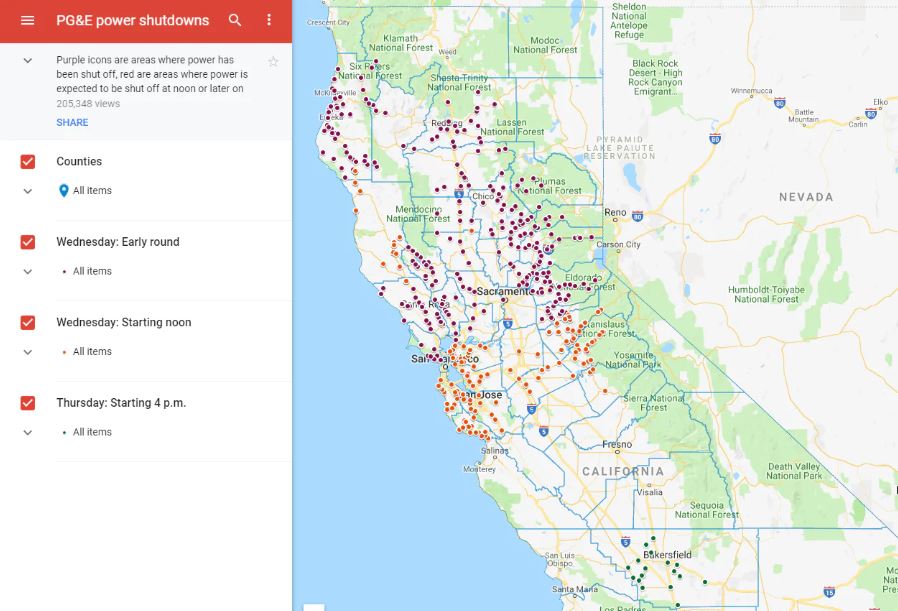
black outs california fireGraphic showing where PG&E shut downs have happened and are expected. (Mercury News)
The first wave of PG&E's shut-offs began early Wednesday. Among the 513,000 customers to lose electricity were those in Wine Country, as Sonoma and Napa counties went dark before the break of dawn.
As of midmorning Wednesday, gusts of 24 mph were reported in Sacramento, and while temperatures in the Central Valley were expected to climb into the upper 70s, dew points were in the low- to mid-30s. Wind speeds and high gusts are expected to increase into Wednesday night before spreading south.
The Sacramento Bee reported that Michael Lewis, senior vice president of PG&E's electric operations, said in a prepared statement that it could take "several days to fully restore power after the weather passes and safety inspections are completed."
Of course, such a widespread disruption to the power grid is certain to pack numerous adverse consequences.
For example, the publication CalMatters reported PG&E's actions will keep 108,000 schoolchildren, from more than 260 schools in 50 districts across 14 counties, out of classrooms Wednesday. The University of California-Berkeley canceled classes for the day, with a decision about the rest of the week to come midday Wednesday.
To help mitigate the inconveniences, PG&E has set up "Community Resource Centers," where people without power can access restrooms, bottled water, electronic-device charging and seating in climate-controlled conditions.
Although PG&E announced the shut-offs nearly two days before the windstorm's arrival, there were struggles getting the word out. On Tuesday morning, the utility's website was down; that evening, the site was prompting the Firefox browser to issue a warning of a potential security risk.
Even local law enforcement jabbed the plan, with the Pleasanton Police Department sharing a meme of frustration with PG&E.
Beyond the problems with its communications, PG&E's strategy of cutting power to save lives also came under criticism for its unsustainability. Suggested long-term remedies are microgrids, buried lines and better building standards.
2019 © The Washington Post
This article was originally published by The Washington Post.