Friday, October 11, 2019

Turkey and the Kurds: It’s More Complicated Than You Think

Turkey and the Kurds: It’s More Complicated Than You Think


We are grateful for the Kurds’ help, and we should try to help them in return. But no one wants to risk war with Turkey.

On Monday, President Trump announced that a contingent of fewer than 100 U.S. troops in Syria was being moved away from Kurdish-held territory on the border of Turkey. The move effectively green-lighted military operations by Turkey against the Kurds, which have now commenced.
Some U.S. military officials went public with complaints about being “blindsided.” The policy cannot have been a surprise, though. The president has made no secret that he wants out of Syria, where we now have about 1,000 troops (down from over 2,000 last year). More broadly, he wants our forces out of the Middle East. He ran on that position. I’ve argued against his “endless wars” tropes, but his stance is popular. As for Syria specifically, many of the president’s advisers think we should stay, but he has not been persuaded.
The president’s announcement of the redeployment of the Syrian troops came on the heels of a phone conversation with Turkey’s President Recep Tayyip Erdogan. This, obviously, was a mistake, giving the appearance (and not for the first time) that Trump is taking cues from Ankara’s Islamist strongman. As has become rote, the inevitable criticism was followed by head-scratching tweets: The president vows to “totally destroy and obliterate the Economy of Turkey,” which “I’ve done before” (huh?), if Turkey takes any actions “that I, in my great and unmatched wisdom, consider to be off limits.” We can only sigh and say it will be interesting to see how the president backs up these haughty threats now that Erdogan has begun his invasion.
All that said, the president at least has a cogent position that is consistent with the Constitution and public opinion. He wants U.S. forces out of a conflict in which America’s interests have never been clear, and for which Congress has never approved military intervention. I find that sensible — no surprise, given that I have opposed intervention in Syria from the start (see, e.g., here, here, here, here, here, here, and here). The stridency of the counterarguments is matched only by their selectiveness in reciting relevant facts.
I thus respectfully dissent from our National Review editorial.

President Trump, it says, is “making a serious mistake” by moving our forces away from what is described as “Kurdish territory”; the resulting invasion by superior Turkish forces will “kill American allies” while “carving out a zone of dominance” that will serve further to “inflame and complicate” the region.
Where to begin? Perhaps with the basic fact that there is no Kurdish territory. There is Syrian territory on Turkey’s border that the Kurds are occupying — a situation that itself serves to “inflame and complicate” the region for reasons I shall come to. Ethnic Kurds do not have a state. They live in contiguous parts of Syria, Turkey, Iraq, and Iran. Most are integrated into these countries, but many are separatists.
The Kurds have been our allies against ISIS, but it is not for us that they have fought. They fight ISIS for themselves, with our help. They are seeking an autonomous zone and, ultimately, statehood. The editorial fails to note that the Kurds we have backed, led by the YPG (People’s Protection Units), are the Syrian branch of the PKK (the Kurdistan Worker’s Party) in Turkey. The PKK is a militant separatist organization with Marxist-Leninist roots. Although such informed observers as Michael Rubin contend that the PKK has “evolved,” it remains a formally designated foreign terrorist organization under U.S. law. While our government materially supports the PKK’s confederates, ordinary Americans have been prosecuted for materially supporting the PKK.
The PKK has a long history of conducting terrorist attacks, but their quarrel is not with us. So why has our government designated them as terrorists? Because they have been fighting an insurgent war against Turkey for over 30 years. Turkey remains our NATO ally, even though the Erdogan government is one of the more duplicitous and anti-Western actors in a region that teems with them — as I’ve detailed over the years (see, e.g., here, here, here, here, and in my 2012 book, Spring Fever). The Erdogan problem complicates but does not change the fact that Turkey is of great strategic significance to our security.
While it is a longer discussion, I would be open to considering the removal of both the PKK from the terrorist list and Turkey from NATO. For now, though, the blunt facts are that the PKK is a terrorist organization and Turkey is our ally. These are not mere technicalities. Contrary to the editorial’s suggestion, our government’s machinations in Syria have not put just one of our allies in a bind. There are two allies in this equation, and our support for one has already vexed the other. The ramifications are serious, not least Turkey’s continued lurch away from NATO and toward Moscow.
Without any public debate, the Obama administration in 2014 insinuated our nation into the Kurdish–Turk conflict by arming the YPG. To be sure, our intentions were good. ISIS had besieged the city of Kobani in northern Syria; but Turkey understandably regards the YPG as a terrorist organization, complicit in the PKK insurgency.
That brings us to another non-technicality that the editors mention only in passing: Our intervention in Syria has never been authorized by Congress. Those of us who opposed intervention maintained that congressional authorization was necessary because there was no imminent threat to our nation. Contrary to the editorial’s suggestion, having U.S. forces “deter further genocidal bloodshed in northern Syria” is not a mission for which Americans support committing our men and women in uniform. Such bloodlettings are the Muslim Middle East’s default condition, so the missions would never end.
A congressional debate should have been mandatory before we jumped into a multi-layered war, featuring anti-American actors and shifting loyalties on both sides. In fact, so complex is the situation that President Obama’s initial goal was to oust Syria’s Assad regime; only later came the pivot to fighting terrorists, which helped Assad. That is Syria: Opposing one set of America’s enemies only empowers another. More clear than what intervention would accomplish was the likelihood of becoming enmeshed, inadvertently or otherwise, in vicious conflicts of which we wanted no part — such as the notorious and longstanding conflict between Turks and Kurds.
Barbaric jihadist groups such as ISIS (an offshoot of al-Qaeda) come into existence because of Islamic fundamentalism. But saying so remains de trop in Washington. Instead, we tell ourselves that terrorism emerges due to “vacuums” created in the absence of U.S. forces. On this logic, there should always and forever be U.S. forces and involvement in places where hostility to America vastly outweighs American interests.
President Obama has wrongly been blamed for “creating” ISIS by leaving a vacuum in Iraq. Couldn’t be the sharia-supremacist culture, could it? No, we’re supposed to suppose that this sort of thing could happen anywhere. So, when Obama withdrew our forces from the region (as Trump is doing now), jihadist atrocities and territorial conquests ensued. Eventually, Obama decided that action needed to be taken. But invading with U.S. troops was not an option — it would have been deeply unpopular and undercut Obama’s tout that Islamic militarism was on the wane. Our government therefore sought proxy forces.
Most proved incompetent. The Kurds, however, are very capable. There was clamor on Capitol Hill to back them. We knew from the first, though, that supporting them was a time bomb. Turkey was never going to countenance a Kurdish autonomous zone, led by the YPG and PKK elements, on its Syrian border. Ankara was already adamant that the PKK was using the Kurdish autonomous zone in Iraq to encourage separatist uprisings in Turkey, where 20 percent of the population is Kurdish. Erdogan would never accept a similar arrangement in Syria; he would evict the YPG forcibly if it came to that.
Yes, we had humanitarian reasons for arming the Kurds. But doing so undermined our anti-terrorism laws while giving Erdogan incentive to align with Russia and mend fences with Iran. ISIS, meanwhile, has never been defeated — it lost its territorial “caliphate,” but it was always more lethal as an underground terrorist organization than as a quasi-sovereign struggling to hold territory. And al-Qaeda, though rarely spoken of in recent years, is ascendant — as threatening as it has been at any time since its pre-9/11 heyday.
Those of us opposed to intervention in Syria wanted Congress to think through these quite predictable outcomes before authorizing any further U.S. military involvement in this wretched region. Congress, however, much prefers to lay low in the tall grass, wait for presidents to act, and then complain when things go awry.
And so they have: The easily foreseeable conflict between Turkey and the Kurds is at hand. We are supposed to see the problem as Trump’s abandoning of U.S. commitments. But why did we make commitments to the Kurds that undermined preexisting commitments to Turkey? The debate is strictly framed as “How can we leave the Kurds to the tender mercies of the Turks?” No one is supposed to ask “What did we expect would happen when we backed a militant organization that is tightly linked to U.S.-designated terrorists and that is the bitter enemy of a NATO ally we knew would not abide its presence on the ally’s border?” No one is supposed to ask “What is the end game here? Are we endorsing the partition of Syria? Did we see a Kurdish autonomous zone as the next Kosovo?” (We might remember that recognition of Kosovo’s split from Serbia, over Russian objections, was exploited by the Kremlin as a rationale for promoting separatism and annexations in Georgia and Ukraine.)
It is true, as the editors observe, that “there are no easy answers in Syria.” That is no excuse for offering an answer that makes no sense: “The United States should have an exit strategy, but one that neither squanders our tactical gains against ISIS nor exposes our allies to unacceptable retribution.” Put aside that our arming of the Kurds has already exposed our allies in Turkey to unacceptable risk. What the editorial poses is not an “exit strategy” but its opposite. In effect, it would keep U.S. forces in Syria interminably, permanently interposed between the Kurds and the Turks. The untidy questions of how that would be justifiable legally or politically go unaddressed.
President Trump, by contrast, has an exit strategy, which is to exit. He promises to cripple Turkey economically if the Kurds are harmed. If early reports of Turkey’s military assault are accurate, the president will soon be put to the test. I hope he is up to it. For a change, he should have strong support from Congress, which is threatening heavy sanctions if Turkey routs the Kurds.
Americans, however, are not of a mind to do more than that. We are grateful for what the Kurds did in our mutual interest against ISIS. We should try to help them, but no one wants to risk war with Turkey over them. The American people’s representatives never endorsed combat operations in Syria, and the president is right that the public wants out. Of course we must prioritize the denial of safe havens from which jihadists can attack American interests. We have to stop pretending, though, that if our intentions toward this neighborhood are pure, its brutal history, enduring hostilities, and significant downside risks can be ignored.

TRUMP RIDS MAJOR U.S. CONTAINER PORT OF CHINESE COMMUNIST CONTROL

TRUMP RIDS MAJOR U.S. CONTAINER PORT OF CHINESE COMMUNIST CONTROL

Under a long-term deal sealed by the Obama administration, a Chinese Communist company was set to control the second-busiest container port in the United States. In an unreported Trump administration victory, the Communists are out after a drawn-out national security review forced a unit of China-based COSCO Shipping Holdings Co. (Orient Overseas Container Line—OOCL) to sell the cherished container terminal business, which handles among the largest freight of imports into the U.S.
It all started with a 40-year container terminal lease between the Port of Long Beach in southern California and Hong Kong. The Obama administration proudly signed the agreement in 2012 giving China control of America’s second-largest container port behind the nearby Port of Los Angeles. One of the Trump administration’s first big moves was to get the Communists out of the Port of Long Beach. After a national security review and federal intervention, the Long Beach terminal business, which handles millions of containers annually, is finally being sold to an Australian company called Macquarie Infrastructure Partners. That essentially kills China’s decades-long contract with the Obama administration.
The deal never should have been signed in the first place considering the facility’s size, significance and the national security issues associated with a hostile foreign government controlling it. The southern California port is the premier U.S. gateway for trans-Pacific trade, according to its website, and handles trade valued at more than $194 billion annually. It is one of the few ports that can accommodate the world’s largest vessels and serves 140 shipping lines with connections to 217 seaports around the world. The facility encompasses 3,200 acres with 31 miles of waterfront, 10 piers, 62 berths and 68 post-Panamax gantry cranes. In 2018, the Long Beach port handled more than 8 million container units, achieving the busiest year in its history.
Removing Chinese Communists from this essential port is a tremendous feat and a huge victory for U.S. national security. You’d never know it because the media, consumed with the impeachment debacle, has ignored this important achievement. The only coverage of the finalized transfer is found in Long Beach’s local newspaper, which published a brief article omitting important background information on the Trump administration’s work to take back the terminal from the Communists. The story makes it seem like a regular business transaction in which “a Chinese state-owned company, reached a deal to sell the terminal, one of the busiest in the port, for $1.78 billion.” The piece also quotes the Port of Long Beach’s deputy executive director saying that the transaction process was intricate and involved one of “our most valuable port assets.” Buried at the bottom of the article is a sentence mentioning that the U.S. government, which regulates mergers for antitrust and security reasons, stepped in and required COSCO to sell its rights to the container terminal.

In the last few years China has bought cargo ports throughout the world, including in Latin America, the Indian Ocean and Mediterranean Sea. Chinese-owned ports are located in Greece, Italy, Spain and other European locations. In sub-Saharan Africa there are dozens of existing or planned port projects funded or operated by China, according to a study that highlights the threat the Chinese investments present to U.S. influence in the region. One troubling analysis points out that “COSCO’s commercial expansion has created leverage for Beijing — leverage that has already resulted in countries that host COSCO ports adopting China’s position on key international issues.”

Thursday, October 10, 2019

Trump “abandoning” the Kurds

More news about Trump “abandoning” the Kurds

Don’t get carried away with the claim that Trump is abandoning the Kurds. “The Kurds” are not a single homogeneous people aligned with American values.
KurdsIn an earlier post, I argued that Trump is retreating from the Wilson Doctrine (America must use her blood to bring democracy to other lands) and the Obama Doctrine (America is toxic and can remedy that only by fighting wars against her interests) and instead creating a Trump Doctrine: In any war to which America sends her troops, there must be an immediate and obvious benefit to America. To this end, he’s withdrawing troops from Syria because America cannot endlessly police the internecine warfare that is endemic in the Muslim world.
The objection to America’s withdrawal is that America is abandoning the Kurds. That objection went into overdrive when Turkey instantly bombed “the Kurds.”
Except it’s not that simple, at least according to one source. There are no generic “Kurds.” As with every other region in the Middle East, there are Kurdish factions and not all of them are our friends.
Take a look at this information from a retired Special Forces officer and see if it makes you see things differently (emphasis mine):
Kurds
OK Folks, “Plickee” everybody is going nuts over the removal of about 100 US Troops from Prison Camp Guard duty in northeast Syria and to bring them and their support units home. Folks before you touch the Zippo to the gas soaked scalp, let us cut the BS from the Congressional Employees of the Military Industrial complex.
You can’t tell the players without a scorecard, the map below shows the area occupied by the Kurds over the centuries. Now if you look at the Syrian/Turkey/Iraq border area, that southeast area of Turkey is now mostly flooded by the Ataturk Dam Project, you will see few roads, few towns. Few areas to stage a campaign against the Kurds in Iraq.
 Now there are four different Kurdish groups, we will work on two, the Peshmerga, our allies, over 60,000 strong well equipped, extremely well led, and superbly trained by the “Quiet Professionals” of the US Army Special Forces, and who President Trump will continue to supply and support, even with air cover, if necessary. They are allied with the Syrian Defense Force, and they will probably work together, surrendering Syrian land, if necessary, and moving East back to their homeland.
The other group, mostly concentrated in eastern and southeastern Turkey are the PKK, a Marxist/ Maoist group who have been on the US and world Terrorist list since at least the mid 1980s, they have been the PROVOS, Bader-Meinhof, Japanese Red Army, Black September like group of Turkey blowing up civilians, murdering etc. They are not our friends and allies. They are the Turkish target, oh and the Syrians are also in that area, so if Turks and Syrians murder each other off, don’t cry for me Argentina.  
 Now if the Congress want to do the right thing and establish a formidable ally, who would gladly work with our Israeli, Jordanian, Azerbijanis and other allies in the area, they will petition the UN, ok, you have to check the box, and help the Kurds establish, Kurdistan, and announce to all comers that they are our friends and allies, Iran would go berserk, but then again how many more times can they scream “Death to America.”
Ike warned of the “Military Industrial Complex” (MIC), he led millions of troops and freed millions of people. Lindsay Graham, a USAFR JAG officer, and the other Congresscitters only claim to military fame is how much money the MIC had bribed, I mean donated to their accounts.

The same source adds more information about the factions amongst the Kurds:
OK Folks, some folks have pilloried me for my post about the situation in Syria, and my agreement with pulling the 50-100 us troops from the ISIS Prison Compound and out of way of the Turkish invasion of Northern Syria, screaming that we have abandoned an ally.
We were working with the PESH and SDF against a common foe, a foe the Kurds have been fighting for decades if not centuries, I believe that we should declare our support for a Kurdish Homeland, a Kurdistan, they deserve one.
 Erdogan announced this invasion to whack the PKK months ago, he was coming, he could not back down, he is hanging on by a thread and any sides of weakness and he is gone, a maniac that can’t change his mind, is going to do dumb things.
What if we left them there, made them another Bataan, another Wake Island, and they were attacked in the process of the Turkish attack on the PKK, are we going to drop the 173rd Airborne, the 82nd Airborne, in to reinforce them, against the massive armor and artillery y’all have given them (where they came from is another question), don’t think so, remember they bought the Russian Air to Air missiles, and C-17s are big targets. Guess the stuff we gave the Kurds is worthless, all those vehicles, and ordinance is worthless, and they can’t continue the fight without our 50-100 GIs..
If they got massacred in the fighting, are you going to go with the Notification Teams to each of those one hundred households, and then to all the homes of all those killed, wounded and missing in action when we have to declare war on Turkey for their deaths.
 Trump will always protect America first but, as to the rest of the world, he’s a good friend and a dangerous enemy. He will not abandon the Kurds who are our friends. He will not waste American blood and gold on those Kurds who are not.

Zuckerberg and Crypto (Libra) MBrew

CRYPTO

Mark Zuckerberg Has Angered the Cosmos

Giphy

Whoever’s in charge of scheduling Congress has a wicked sense of humor. 
On Oct. 23, roughly the final day of the Libra zodiac sign, Facebook CEO Mark Zuckerberg will testify before the House Financial Services Committee. While drinking water with an automaton’s precision, Zuckerberg’s expected to defend Facebook’s plans to launch a cryptocurrency...called Libra.
Why Zuck’s on defense: Regulators around the globe say Libra could be used to facilitate money laundering and destabilize the global financial system. Facebook’s (+1.18%) data privacy blunders aren’t helping its cause, either.
  • In July, House Financial Services Chair Maxine Waters called for a moratorium on Libra.
  • President Trump, Fed Chair Jerome Powell, and Treasury Secretary Steven Mnuchin have all knocked the project.
  • French and German finance ministers have pledged to block Libra.
The hearing is a big deal. Zuck needs regulatory approval if he wants Libra to become a force in the payments market, and that’s looking increasingly difficult. That FB’s sending Zuck instead of a henchman shows just how important Libra is to the company’s push into financial services.
        

'Extreme' Fire Threat in California Forces Power Cut For Over 2 Million People

'Extreme' Fire Threat in California Forces Power Cut For Over 2 Million People

MIKE BRANOM, THE WASHINGTON POST
10 OCT 2019
With red-flag warnings in place and an "extreme" fire risk for parts of Northern California on Wednesday that is expected to shift south Thursday, a bout of strong and prolonged winds is prompting Pacific Gas & Electric not to take chances.
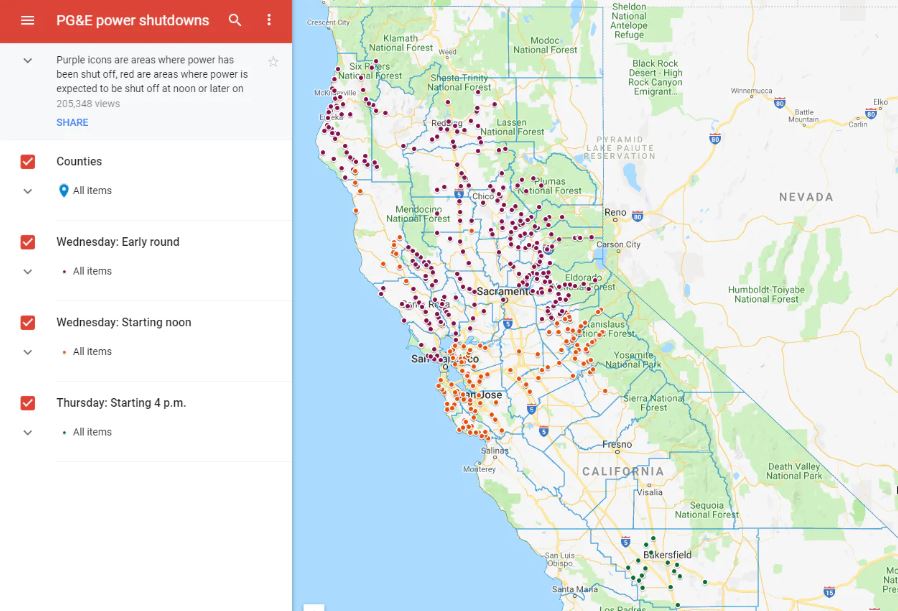
Because the utility giant does not want to risk its grid infrastructure sparking yet another killer wildfire, 800,000 PG&E customers in 34 northern, central and coastal counties (2-plus million people) are having their power cut Wednesday — perhaps for days.
As the wind threat spreads to the south, shutdowns also will affect those in the Southland.
Forecasts call for offshore gusts of warm, bone-dry air up to 70 mph (112 km/h) in the mountains and foothills through Friday, leading the company to concede it is better for people to lose lights, the Internet and other trappings of civilization in a "public safety power shut-off" rather than their lives.
To sound the alarm for strong winds in warm, low-humidity conditions with dry vegetation, National Weather Service offices across the state issued red-flag warnings.
Such warnings are typically issued when gusty winds, low relative humidity and high temperatures mingle to create fire and fire growth potential.
Additionally, the NOAA/NWS Storm Prediction Center's fire weather outlook through Thursday painted "critical" fire danger across much of California, including two pockets of "extreme" conditions, one in the north Wednesday and the other in the south Thursday.
The winds that will be spreading any potential conflagration stem from a powerful storm system expected to wreak havoc across much of the West.
The Weather Prediction Center is forecasting heavy snow and strong winds across parts of the northern Rockies and northern Plains, along with record low temperatures possible across the Northwest on Thursday.
It was less than a year ago when power lines and windy, dry conditions in remote Butte County brewed into the deadliest and most destructive wildfire in California history.
Other power companies across the state announced they were taking the same precautionary measures as PG&E, or at least considering the same.
Southern California Edison said shut-offs could hit nearly 174,000 customers; for San Diego Gas and Electric, the tally approaches 29,000.
black outs california fireGraphic showing where PG&E shut downs have happened and are expected. (Mercury News)
The first wave of PG&E's shut-offs began early Wednesday. Among the 513,000 customers to lose electricity were those in Wine Country, as Sonoma and Napa counties went dark before the break of dawn.
As of midmorning Wednesday, gusts of 24 mph were reported in Sacramento, and while temperatures in the Central Valley were expected to climb into the upper 70s, dew points were in the low- to mid-30s. Wind speeds and high gusts are expected to increase into Wednesday night before spreading south.
The Sacramento Bee reported that Michael Lewis, senior vice president of PG&E's electric operations, said in a prepared statement that it could take "several days to fully restore power after the weather passes and safety inspections are completed."
Of course, such a widespread disruption to the power grid is certain to pack numerous adverse consequences.
For example, the publication CalMatters reported PG&E's actions will keep 108,000 schoolchildren, from more than 260 schools in 50 districts across 14 counties, out of classrooms Wednesday. The University of California-Berkeley canceled classes for the day, with a decision about the rest of the week to come midday Wednesday.
To help mitigate the inconveniences, PG&E has set up "Community Resource Centers," where people without power can access restrooms, bottled water, electronic-device charging and seating in climate-controlled conditions.
Although PG&E announced the shut-offs nearly two days before the windstorm's arrival, there were struggles getting the word out. On Tuesday morning, the utility's website was down; that evening, the site was prompting the Firefox browser to issue a warning of a potential security risk.
Even local law enforcement jabbed the plan, with the Pleasanton Police Department sharing a meme of frustration with PG&E.
Beyond the problems with its communications, PG&E's strategy of cutting power to save lives also came under criticism for its unsustainability. Suggested long-term remedies are microgrids, buried lines and better building standards.
2019 © The Washington Post
This article was originally published by The Washington Post.

Tuesday, October 8, 2019

At least $760 billion of annual U.S. health care spending is considered wasteful.

HEALTH CARE

Stats That Make You Go…“Wow”


20%–25% of U.S. health care spending is wasted annually, according to new research published yesterday in the Journal of the American Medical Association. That made us go “wow” but also “eh, kinda makes sense,” considering the U.S. spends more than any other country on health care at nearly 18% of GDP.
  • FYI, the study’s lead author is the chief medical officer of health insurer Humana.
Back to the numbers: At least $760 billion of annual U.S. health care spending is considered wasteful. Breaking that down...
  • $266 billion is flushed down the toilet on administrative costs, the greatest source of waste.
  • Pricing failure accounts for $231 billion to $241 billion in waste.
  • Other ways we’ve managed to throw money down the drain: Overtreatment and low-value care, fraud and abuse, and failure of care delivery. 
Now that we’ve identified the problem, we can fix it...right? Right? 
"It is likely that substantial waste in U.S. health care spending remains," the study’s authors inform us, but evidence-based interventions could produce "better care at lower cost for all U.S. residents."