Showing posts with label Drug War. Show all posts

Thursday, April 30, 2020

China Is Using Fentanyl as ‘Chemical Warfare

China Is Using Fentanyl as ‘Chemical Warfare,’ Experts Say

 
September 4, 2019 Updated: September 25, 2019
 
 
Behind the deadly opioid epidemic ravaging communities across the United States lies a carefully planned strategy by a hostile foreign power that experts describe as a “form of chemical warfare.”
It involves the production and trafficking of fentanyl, a synthetic opioid that caused the deaths of more than 32,000 Americans in 2018 alone, and fentanyl-related substances.
China is the “largest source” of illicit fentanyl in the United States, a November 2018 report by the U.S.-China Economic and Security Review Commission stated. That same commission said that since its 2017 report, they found no “substantive curtailment” of fentanyl flows from China to the United States. They also noted that in “large part, these flows persist due to weak regulations governing pharmaceutical and chemical production in China.”
President Donald Trump has continued to increase his crackdown on fentanyl—he recently ordered all U.S. carriers to “search for and refuse” international mail deliveries of the synthetic opioid pain reliever. Trump specifically named FedEx, Amazon, UPS, and the U.S. Postal Service (USPS).
Jeff Nyquist, an author and researcher of Chinese and Russian strategy, said China is using fentanyl as a “very effective tool.”
“You could call it a form of chemical warfare,” Nyquist told The Epoch Times. “It opens up a number of opportunities for the penetration of the country, both in terms of laundering money and in terms of blackmail against those who participate in the trade and become corrupt like law enforcement, intelligence, and government officials.” 
China also uses the money generated by the importing of fentanyl to effectively “influence political parties,” according to Nyquist. 
“It opens doors for Chinese influence operations, Chinese People’s Liberation Army, and intelligence services, so that they can get control of certain parts of the U.S.,” he said. 
In August, Trump called out Chinese leader Xi Jinping, accusing him of not doing enough to stop the flow of fentanyl, which enters the United States mostly via international mail.
Liu Yuejin, vice commissioner of the China National Narcotics Control Commission, disputed Trump’s criticism, telling reporters on Sept. 3 that they had started going after illicit fentanyl production, according to state-controlled media. China also denies that most of the illicit fentanyl entering the United States originates in China.
“President Xi said this would stop—it didn’t,” Trump said on Twitter on Aug. 23.
Overdose deaths from synthetic opioids such as fentanyl surged from around 29,000 in 2017 to more than 32,000 in 2018, according to data from the Centers for Disease Control and Prevention (CDC).
Not all opioid-related deaths in the United States can be blamed on China’s fentanyl export policies, as some come from prescription overdoses, according to Dr. Robert J. Bunker, an adjunct research professor at the U.S. Army War College Strategic Studies Institute.
But Bunker told The Epoch Times that China is still “greatly contributing” to America’s opioid epidemic. Bunker described how Beijing is using the trafficking of dangerous drugs to achieve its greater Communist Party goals.
“Contributing to a major health crisis in the U.S., while simultaneously profiting from it would in my mind give long-term CCP plans to establish an authoritarian Chinese global system as a challenge to Western liberal democracy,” he said via email.
“[It’s] a win-win situation for the regime,” he continued. “In fact producing and sending fentanyl to the U.S., which could be considered a low-risk policy of ‘drug warfare,’ is very much in line with the means and methods advocated in the 1999 work ‘Unrestricted Warfare.'”
The book mentioned by Bunker is authored by two of China’s air force colonels, Qiao Liang, and Wang Xiangsui, and published by the People’s Liberation Army.
Recent cases of fentanyl-related overdose and deaths are linked to “illegally made fentanyl,” the CDC has said. Fentanyl is 50 times more potent than heroin and 100 times more potent than morphine.
Fentanyl has been approved for treating severe pain for conditions such as late-stage cancer. It is prescribed by doctors typically through transdermal patches or lozenges. Fentanyl should only be prescribed by doctors who are experienced in treating pain in cancer patients, according to Medline Plus, an online site by the United States National Library of Medicine. It may become addictive, especially with prolonged use.
A USPS spokesman told The Epoch Times they are “aggressively working” to add in provisions from the STOP Act. The Synthetics Trafficking and Overdose Prevention legislation, signed in 2018 by Trump, aims to curb the flow of opioids sent through the mail while increasing coordination between USPS and the U.S. Customs and Border Protection (CBP).
USPS has notified China’s postal operations that if any of their shipments don’t contain Advance Electronic Data (AED), they “may be returned at any time,” the spokesman said via email. CBP is also notifying air and ocean carriers to confirm that 100 percent of their postal shipment containers have AED before loading them onto their conveyance.

Recent Seizures

In August, law enforcement seized 30 kilograms (around 66 pounds) of fentanyl, among other narcotics as part of a major arrest operation over the course of three days. As a result, officers arrested 35 suspects for “conspiracy to distribute and possess with intent to distribute large amounts of heroin, fentanyl, cocaine, and cocaine base.”
G. Zachary Terwilliger, U.S. Attorney for the Eastern District of Virginia, said in a statement that the amount of fentanyl seized was enough to “kill over 14 million people.” One of the suspects in Virginia had ordered the fentanyl from a vendor in Shanghai and was receiving it at his residence through USPS, according to the indictment.
“The last thing we want is for the U.S. Postal Service to become the nation’s largest drug dealer, and there are people way above my pay grade working on that, but absolutely, it’s about putting pressure on the Chinese,” Terwilliger said.
CBP Enforcement Statistics reveal that fiscal year seizures of illicit fentanyl spiked from about one kilogram (2.2 pounds) in 2013 to nearly 1,000 kilograms (2,200 pounds) in 2018. The number of law enforcement fentanyl seizures in the United States also vaulted from about 1,000 in 2013 to more than 59,000 in 2017.
Also, in August, the Mexican navy found 52,000 pounds of fentanyl powder in a container from a Danish ship that was coming from Shanghai. The navy intercepted the unloaded 40-foot container on Aug. 24, at the Port of Cardenas.
“There is clear evidence that fentanyl or fentanyl precursors, chemicals used to make fentanyl is coming from China,” Dr. Andrew Kolodny, co-director of Opioid Policy Research at the Heller School for Social Policy and Management, told The Epoch Times.
  Two commonly used fentanyl precursors are chemicals called NPP and 4-ANPP. In early 2017, journalist Ben Westhoff started researching the chemicals, finding many advertisements for them all over the internet from different companies. He later determined a majority of those companies were under a Chinese chemical company called Yuancheng, according to an excerpt from his upcoming book “Fentanyl, Inc.: How Rogue Chemists Are Creating the Deadliest Wave of the Opioid Epidemic,” an excerpt of which was published in The Atlantic.

Fentanyl Analogs

One of the concerns related to the production of illicit opioids is the creation of fentanyl analogs, products that are similar to fentanyl and also simple to make.
“You can very easily manipulate the molecule and create a new fentanyl-like product that hasn’t been banned, that’s not technically illegal,” Kolodny told The Epoch Times. “Some of the manufacturers, the folks creating the drugs, are aware of that.”
“We saw this with other synthetic drugs that are abused in the U.S., when law enforcement make the drug illegal or when they ban the molecule,” he said. In some cases, fentanyl analogs are even stronger than fentanyl. There’s an analog called carfentanil, which is even more potent than fentanyl.” 
Carfentanil has a quantitative potency “approximately 10,000 times that of morphine and 100 times that of fentanyl,” according to the National Center for Biotechnology Information.
Just one microgram is needed for carfentanil to affect a human. The drug is “one of the most potent opioids known” and is marketed under the trade name Wildnil “as a general anesthetic agent for large animals.”
“Sometimes, it’s hard for law enforcement to keep up with the chemist,” Kolodny added. 
A bill dubbed the SOFA Act or the “Stopping Overdoses of Fentanyl Analogues Act,” has yet to pass Congress. The act was introduced in May by Republican senators and would give law enforcement “enhanced tools to combat the opioid epidemic and close a loophole in current law that makes it difficult to prosecute crimes involving some synthetic opioids.”
Kolodny said pharmaceutical industries have been lobbying to stop any legislation meant to restrict fentanyl analogs “because these are products they are trying to bring to market.” 
In August, an Oklahoma judge ordered Johnson & Johnson to pay $572.1 million to the state for deceitfully marketing addictive opioids. The sum was less than what investors had expected, according to Reuters, which resulted in shares of the multinational corporation rising in value.
“We should be doing everything we can to keep fentanyl out of the country,” Kolodny said. “We should be doing everything we can to ban fentanyl analogs.” 

Billion-Dollar Grants

As part of the Trump administration’s latest efforts to combat the opioid crisis, the U.S. Department of Health and Human Services (HHS) on Sept. 4 announced nearly $2 billion in funding to states.
The funding would expand access to treatment and also support near-real-time data on the drug overdose crisis, according to a release.
In announcing the move, White House counsel Kellyanne Conway told reporters in a conference call that their administration is trying to interject the word “fentanyl” into the “everyday lexicon” as part of their efforts to increase awareness.
Data suggests that of the approximately 2 million Americans suffering from opioid use disorder, approximately 1.27 million of them are now receiving medication-assisted treatment, according to the HHS.
“Central to our effort to stop the flood of fentanyl and other illicit drugs is our unprecedented support for law enforcement and their interdiction efforts,” she said.
Conway then brought up the DHS seizures of fentanyl in 2018, which totaled an equivalent of 1.2 billion lethal doses.
“Ladies and gentlemen, that is enough to have killed every American four times,” she told reporters.
Just weeks ago, the White House released a series of private-sector advisories aimed to help businesses protect themselves and their supply chains from inadvertently trafficking fentanyl and synthetic opioids.
The four advisories aim to stem the production and sale of illicit fentanyl, fentanyl analogs, and other synthetic opioids. The advisories focus on the manufacturing, marketing, movement, and monetary aspects of illicit fentanyl.
In March 2018, the Interior Department created a task force aimed to specifically combat the crisis on tribal lands. Since then, the department has arrested more than 422 individuals and seized 4,000 pounds of illegal drugs worth $12 million on the street, including more than 35,000 fentanyl pills.
Conway, on the conference call, described the epidemic of pain relievers as an “opioid and fentanyl crisis.”
Follow Bowen on Twitter: @BowenXiao_

Sunday, December 1, 2019

Chronicle exclusive: Bay Area death toll from drug overdoses passes 10,000

Chronicle exclusive: Bay Area death toll from drug overdoses passes 10,000

Stevon Williams (right), a homeless veteran, describes the effects of the “goofball,” a potent combo of meth and fentanyl. With him on a plaza near the Embarcadero is David Valenzuela.Photo: Nick Otto / Special to The Chronicle
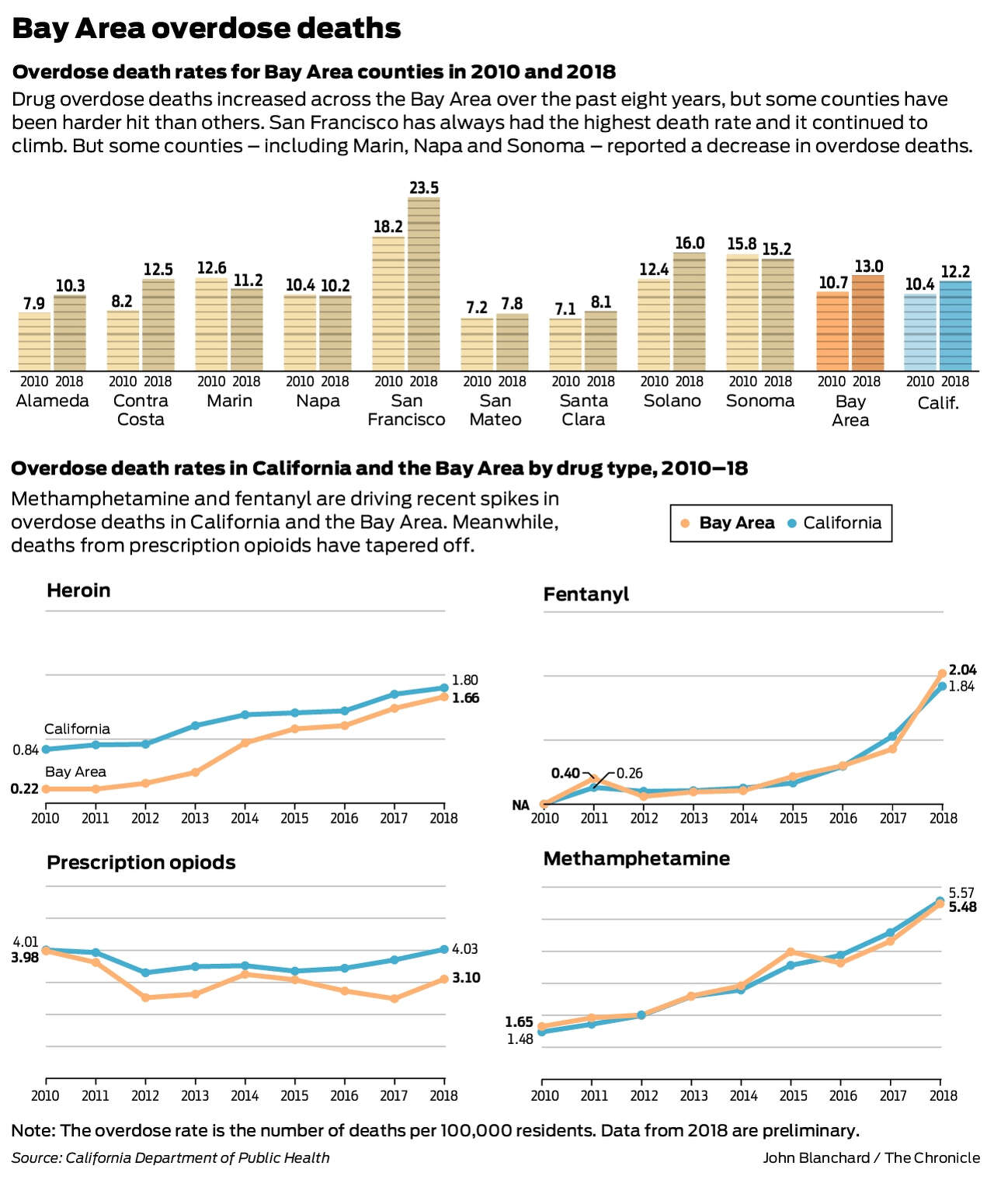
More than 10,000 people have died across the Bay Area in the drug overdose epidemic, but the main killer hasn’t been prescription painkillers for several years — methamphetamine is now the biggest cause of deaths, and overdoses on the superpotent opioid fentanyl are spiking.
Nationally, hundreds of thousands of people have died in the opioid overdose crisis, using prescription painkillers and similar street drugs like heroin and fentanyl.
The Bay Area was never as hard hit as other parts of the country by prescription opioid overdoses. But it has endured an epidemic of deaths from a variety of other street drugs that is continuing to evolve and concern public health officials.
  •  A Chronicle analysis of data from the California Department of Public Health found that 10,005 people have died in the nine Bay Area counties since the state began tracking overdose deaths in 2006, though that is almost certainly fewer than the number of actual drug deaths.
The methamphetamine crisis is a new-old problem, public health officials said. Meth was widespread in the 1990s and never really went away, but the number of people now dying from it — and from dangerous combinations of methamphetamine and potent opioids like fentanyl — is new, and alarming.
“It’s the new speedball,” said 58-year-old Stevon Williams, a homeless Air Force veteran in San Francisco, describing the “goofball,” which is replacing the old injection combination of cocaine and heroin. “That combo of meth and fentanyl does the same thing. A lot of people like that.” Though the public health data demonstrate shifting drug-use trends across the state, it is less precise at capturing overdose deaths caused by multiple drugs. Indeed, the state data as a whole are more subjective than most public health experts would like. It’s dependent upon how coroners and others label the cause of death, and some deaths are investigated much more thoroughly than others.
“It’s important when we’re thinking about overdose deaths that what we’re looking at isn’t necessarily the truth with a capital T,” said Dr. Matt Willis, public health officer for Marin County. “There’s a lot of bias built into the reporting.”
But the data back up what health care providers, addiction experts and users themselves are experiencing firsthand: Drug overdoses, even in communities spared from the worst of the opioid epidemic, are a public health crisis.
Geographic variations: The data were obtained from the California Opioid Overdose Surveillance Dashboard, and the Chronicle analysis is a unique examination of the drug overdose epidemic in the Bay Area as a region.
The Bay Area consistently has had somewhat lower rates of prescription opioid overdose deaths than the rest of the state, especially compared with some rural counties in Northern California where rates were 10 or 20 times higher. But for all drug overdoses, the Bay Area as a whole comes in close to the state average, about 10 to 12 deaths per 100,000 people per year.
Some local counties are notably higher than others. San Francisco has the highest rates of drug overdose deaths — about 23 per 100,000 in 2018. The North Bay counties of Sonoma and Solano also have higher death rates than the Bay Area average, about 15 per 100,000.
Santa Clara and San Mateo have the lowest rates, around 8 deaths per 100,000 last year.
“There are marked differences in relatively small geographic areas. I couldn’t tell you why,” said Dr. Scott Morrow, public health officer for San Mateo County.
Drug overdose deaths have been up and down during the past decade in the Bay Area, but they reached a decade high of 13 deaths per 100,000 residents in 2018, according to preliminary state data.
The overall death toll doesn’t tell the whole story, though.
Prescription overdose death rates have fallen slightly in the Bay Area, but deaths from heroin have been steadily increasing. And deaths from fentanyl — a synthetic opioid about 50 times more potent than heroin — have exploded in the past four years.
Opioids as a whole are still bigger killers than methamphetamine alone. But meth stands apart as the single largest killer. And that has public health officials concerned — and confused.
“Meth is not usually a very deadly drug,” said Dr. Daniel Ciccarone, a national drug use and policy expert at UCSF.
Opioids, and especially fentanyl, are so deadly because they can quickly shut down the respiratory system. Methamphetamine kills by essentially overstimulating the heart or the brain, leading to a heart attack or stroke. But in the past, only people who already had cardiovascular issues were at risk of overdoing it with meth — now, younger, otherwise healthy people are dying too.
The rise in meth overdose deaths raises questions, Ciccarone said. Are more people using meth? Is the drug itself different and more potent? Does combining meth with fentanyl make it deadlier?
Ciccarone said investigations of the drug supply have found that the meth sold in the United States is indeed stronger than what people were using 10 or 20 years ago, when meth was primarily made in backyard labs. It’s now manufactured by global drug cartels.
“We have a drug coming in that’s at 90% purity and much higher potency. But we need more studies to say if the meth is more deadly,” Ciccarone said.
Deadly combinations: Combining drugs, especially meth with an opioid like fentanyl, is especially concerning to public health officials. It’s difficult to track those deaths, and dual addictions are more complicated to treat.
Purposely taking methamphetamine with fentanyl, one hit after the other, is like juggling dynamite — but hard-core addicts say they need it. The high of the methamphetamine sometimes needs counteracting with the chill-out effect of the fentanyl, they say. Or the deeply sedated state caused by fentanyl has to be offset by the rush of meth.
“Speed a lot of times gets you geeked out, with your heart racing and your head pounding, and then fentanyl evens you out,” said Shauna Arteago, 45, who has been homeless but now lives in a San Francisco single-room apartment. “I smoke them one at a time, and you’ve got to be careful, because fentanyl can kill you. I’ve overdosed three times, the last time a few months ago.”
Those who work daily with addicts on the street don’t need statistics to tell them the overdose problem is growing — particularly among the homeless.
Capt. Carl Fabbri, commander of the Tenderloin Police Station, said he often feels like he’s shoveling sand into tides when he and his officers try to intervene with addicts on the street, and it’s heartbreaking.
“We’ve made progress on the dealers, but the victims — the users? It’s almost out of our hands, there are so many,” he said. “It is terribly sad.”
A 39-year-old homeless longtime addict who goes by the street name of Country fired up a bubble — pipe load — of meth near the Ferry Building and said overdoses and addictions in the street “have gotten off the hook in the last year or so.”
“It’s so much more than ever, and I’ve seen it all,” he said.
“It makes me sad seeing so many people do so much drugs out here, but we’re stuck. We need help. You think we all want to be addicted to this crap? No way.”
San Francisco public health officials, who have been collecting data on overdose deaths involving more than one drug, say their analyses show that overdose rates with both meth and fentanyl have more than doubled in just the past two years.
A decade ago, meth was causing only a dozen or so deaths a year and fentanyl wasn’t even tracked. In 2018, roughly 50 people died with both drugs in their system — dozens more died from one or the other.
“The reality is that most drug use is poly drug use. It’s not unusual for people to be using more than one drug,” said Dr. Phillip Coffin, director of substance use research for the San Francisco Department of Public Health.
Combining meth and fentanyl may be especially risky for a lot of reasons, among them that meth, in particular, leads to “chaotic behaviors” that may prevent people from practicing safer drug practices, he said.
For example, harm-reduction experts advise than anyone using fentanyl start with a small dose and that they never get high alone, so that if they overdose, someone can treat them with Narcan. But if they’re using meth too, people may not be thinking clearly enough to take those precautions.
The “goofball” is not just a San Francisco problem. What’s not clear from data and anecdotal information is how often people are choosing to combine meth with an opioid verus being “poisoned” by fentanyl that is sometimes added to other drugs without users knowing it, public health officials say.
Fentanyl isn’t necessarily pervasive in all Bay Area counties just yet — or it’s not being identified as a cause of death. But not all counties have the laboratory resources to test for the specific opioid found in a person after death. When fentanyl is identified in an overdose, it’s often impossible to know whether the person chose to use it or took it by accident.
“The combination of opioids and stimulants is common,” said Dr. Ori Tzvieli, deputy health officer with Contra Costa County. “But did they die because they were a meth addict and they ended up buying some with fentanyl in it? Or did they die because they’re someone with an opioid overuse disorder who’s using fentanyl now?”
Erin Allday and Kevin Fagan are San Francisco Chronicle staff writers. Email: eallday@sfchronicle.comkfagan@sfchronicle.com Twitter: @erinallday@KevinChron

Saturday, September 7, 2019

China Is Using Fentanyl as ‘Chemical Warfare,

China Is Using Fentanyl as ‘Chemical Warfare,’ Experts Say

September 4, 2019 Updated: September 5, 2019
Behind the deadly opioid epidemic ravaging communities across the United States lies a carefully planned strategy by a hostile foreign power that experts describe as a “form of chemical warfare.”
It involves the production and trafficking of fentanyl, a synthetic opioid that caused the deaths of more than 32,000 Americans in 2018 alone, and fentanyl-related substances.
China is the “largest source” of illicit fentanyl in the United States, a November 2018 report by the U.S.-China Economic and Security Review Commission stated. That same commission said that since its 2017 report, they found no “substantive curtailment” of fentanyl flows from China to the United States. They also noted that in “large part, these flows persist due to weak regulations governing pharmaceutical and chemical production in China.”
President Donald Trump has continued to increase his crackdown on fentanyl—he recently ordered all U.S. carriers to “search for and refuse” international mail deliveries of the synthetic opioid pain reliever. Trump specifically named FedEx, Amazon, UPS, and the U.S. Postal Service (USPS).
Jeff Nyquist, an author and researcher of Chinese and Russian strategy, said China is using fentanyl as a “very effective tool.”
“You could call it a form of chemical warfare,” Nyquist told The Epoch Times. “It opens up a number of opportunities for the penetration of the country, both in terms of laundering money and in terms of blackmail against those who participate in the trade and become corrupt like law enforcement, intelligence, and government officials.” 
China also uses the money generated by the importing of fentanyl to effectively “influence political parties,” according to Nyquist. 
“It opens doors for Chinese influence operations, Chinese People’s Liberation Army, and intelligence services, so that they can get control of certain parts of the U.S.,” he said. 
In August, Trump called out Chinese leader Xi Jinping, accusing him of not doing enough to stop the flow of fentanyl, which enters the United States mostly via international mail.
Liu Yuejin, vice commissioner of the China National Narcotics Control Commission, disputed Trump’s criticism, telling reporters on Sept. 3 that they had started going after illicit fentanyl production, according to state-controlled media. China also denies that most of the illicit fentanyl entering the United States originates in China.
“President Xi said this would stop—it didn’t,” Trump said on Twitter on Aug. 23.
Overdose deaths from synthetic opioids such as fentanyl surged from around 29,000 in 2017 to more than 32,000 in 2018, according to data from the Centers for Disease Control and Prevention (CDC).
Not all opioid-related deaths in the United States can be blamed on China’s fentanyl export policies, as some come from prescription overdoses, according to Dr. Robert J. Bunker, an adjunct research professor at the U.S. Army War College Strategic Studies Institute.
But Bunker told The Epoch Times that China is still “greatly contributing” to America’s opioid epidemic. Bunker described how Beijing is using the trafficking of dangerous drugs to achieve its greater Communist Party goals.
“Contributing to a major health crisis in the U.S., while simultaneously profiting from it would in my mind give long-term CCP plans to establish an authoritarian Chinese global system as a challenge to Western liberal democracy,” he said via email.
“[It’s] a win-win situation for the regime,” he continued. “In fact producing and sending fentanyl to the U.S., which could be considered a low-risk policy of ‘drug warfare,’ is very much in line with the means and methods advocated in the 1999 work ‘Unrestricted Warfare.'”
The book mentioned by Bunker is authored by two of China’s air force colonels, Qiao Liang, and Wang Xiangsui, and published by the People’s Liberation Army.

Recent cases of fentanyl-related overdose and deaths are linked to “illegally made fentanyl,” the CDC has said. Fentanyl has been approved for treating severe pain for conditions such as late-stage cancer. Fentanyl is 50 times more potent than heroin and 100 times more potent than morphine. It is prescribed by doctors through transdermal patches or lozenges.
A USPS spokesman told The Epoch Times they are “aggressively working” to add in provisions from the STOP Act. The Synthetics Trafficking and Overdose Prevention legislation, signed in 2018 by Trump, aims to curb the flow of opioids sent through the mail while increasing coordination between USPS and the U.S. Customs and Border Protection (CBP).
USPS has notified China’s postal operations that if any of their shipments don’t contain Advance Electronic Data (AED), they “may be returned at any time,” the spokesman said via email. CBP is also notifying air and ocean carriers to confirm that 100 percent of their postal shipment containers have AED before loading them onto their conveyance.

Recent Seizures

In August, law enforcement seized 30 kilograms (around 66 pounds) of fentanyl, among other narcotics as part of a major arrest operation over the course of three days. As a result, officers arrested 35 suspects for “conspiracy to distribute and possess with intent to distribute large amounts of heroin, fentanyl, cocaine, and cocaine base.”
G. Zachary Terwilliger, U.S. Attorney for the Eastern District of Virginia, said in a statement that the amount of fentanyl seized was enough to “kill over 14 million people.” One of the suspects in Virginia had ordered the fentanyl from a vendor in Shanghai and was receiving it at his residence through USPS, according to the indictment.
“The last thing we want is for the U.S. Postal Service to become the nation’s largest drug dealer, and there are people way above my pay grade working on that, but absolutely, it’s about putting pressure on the Chinese,” Terwilliger said.
CBP Enforcement Statistics reveal that fiscal year seizures of illicit fentanyl spiked from about one kilogram (2.2 pounds) in 2013 to nearly 1,000 kilograms (2,200 pounds) in 2018. The number of law enforcement fentanyl seizures in the United States also vaulted from about 1,000 in 2013 to more than 59,000 in 2017.
Also, in August, the Mexican navy found 52,000 pounds of fentanyl powder in a container from a Danish ship that was coming from Shanghai. The navy intercepted the unloaded 40-foot container on Aug. 24, at the Port of Cardenas.
“There is clear evidence that fentanyl or fentanyl precursors, chemicals used to make fentanyl is coming from China,” Dr. Andrew Kolodny, co-director of Opioid Policy Research at the Heller School for Social Policy and Management, told The Epoch Times.
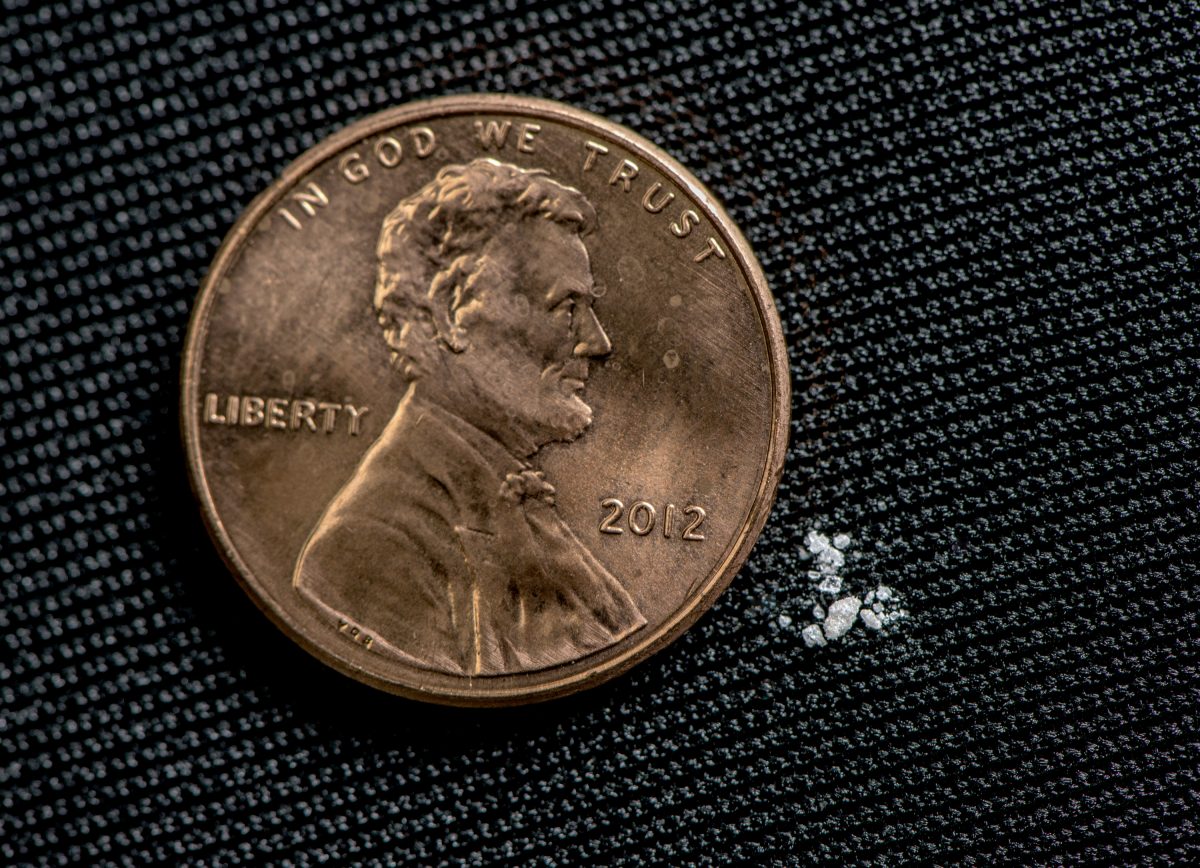
A fatal dose of fentanyl displayed next to a penny. (DEA)
Two commonly used fentanyl precursors are chemicals called NPP and 4-ANPP. In early 2017, journalist Ben Westhoff started researching the chemicals, finding many advertisements for them all over the internet from different companies. He later determined a majority of those companies were under a Chinese chemical company called Yuancheng, according to an excerpt from his upcoming book “Fentanyl, Inc.: How Rogue Chemists Are Creating the Deadliest Wave of the Opioid Epidemic,” an excerpt of which was published in The Atlantic.

Fentanyl Analogs

One of the concerns related to the production of illicit opioids is the creation of fentanyl analogs, products that are similar to fentanyl and also simple to make.
“You can very easily manipulate the molecule and create a new fentanyl-like product that hasn’t been banned, that’s not technically illegal,” Kolodny told The Epoch Times. “Some of the manufacturers, the folks creating the drugs, are aware of that.”
“We saw this with other synthetic drugs that are abused in the U.S., when law enforcement make the drug illegal or when they ban the molecule,” he said. In some cases, fentanyl analogs are even stronger than fentanyl. There’s an analog called carfentanil, which is even more potent than fentanyl.” 
Carfentanil has a quantitative potency “approximately 10,000 times that of morphine and 100 times that of fentanyl,” according to the National Center for Biotechnology Information.
Just one microgram is needed for carfentanil to affect a human. The drug is “one of the most potent opioids known” and is marketed under the trade name Wildnil “as a general anesthetic agent for large animals.”
“Sometimes, it’s hard for law enforcement to keep up with the chemist,” Kolodny added. 
A bill dubbed the SOFA Act or the “Stopping Overdoses of Fentanyl Analogues Act,” has yet to pass Congress. The act was introduced in May by Republican senators and would give law enforcement “enhanced tools to combat the opioid epidemic and close a loophole in current law that makes it difficult to prosecute crimes involving some synthetic opioids.”
Kolodny said pharmaceutical industries have been lobbying to stop any legislation meant to restrict fentanyl analogs “because these are products they are trying to bring to market.” 
In August, an Oklahoma judge ordered Johnson & Johnson to pay $572.1 million to the state for deceitfully marketing addictive opioids. The sum was less than what investors had expected, according to Reuters, which resulted in shares of the multinational corporation rising in value.
“We should be doing everything we can to keep fentanyl out of the country,” Kolodny said. “We should be doing everything we can to ban fentanyl analogs.” 

Billion-Dollar Grants

As part of the Trump administration’s latest efforts to combat the opioid crisis, the U.S. Department of Health and Human Services (HHS) on Sept. 4 announced nearly $2 billion in funding to states.
The funding would expand access to treatment and also support near-real-time data on the drug overdose crisis, according to a release.
In announcing the move, White House counsel Kellyanne Conway told reporters in a conference call that their administration is trying to interject the word “fentanyl” into the “everyday lexicon” as part of their efforts to increase awareness.
Data suggests that of the approximately 2 million Americans suffering from opioid use disorder, approximately 1.27 million of them are now receiving medication-assisted treatment, according to the HHS.
“Central to our effort to stop the flood of fentanyl and other illicit drugs is our unprecedented support for law enforcement and their interdiction efforts,” she said.
Conway then brought up the DHS seizures of fentanyl in 2018, which totaled an equivalent of 1.2 billion lethal doses.
“Ladies and gentlemen, that is enough to have killed every American four times,” she told reporters.
Just weeks ago, the White House released a series of private-sector advisories aimed to help businesses protect themselves and their supply chains from inadvertently trafficking fentanyl and synthetic opioids.
The four advisories aim to stem the production and sale of illicit fentanyl, fentanyl analogs, and other synthetic opioids. The advisories focus on the manufacturing, marketing, movement, and monetary aspects of illicit fentanyl.
In March 2018, the Interior Department created a task force aimed to specifically combat the crisis on tribal lands. Since then, the department has arrested more than 422 individuals and seized 4,000 pounds of illegal drugs worth $12 million on the street, including more than 35,000 fentanyl pills.
Conway, on the conference call, described the epidemic of pain relievers as an “opioid and fentanyl crisis.”

Follow Bowen on Twitter: @BowenXiao3