Move over, Crazy Bernie, you’re no longer the left’s heartthrob. You’ve been replaced by Alexandria Ocasio-Cortez, an out-of-the-closet socialist from New York City who will enter Congress next January after beating a member of the Democratic leadership.
Referring to the boomlet she’s created, I’ve already written about why young people are deluded if they think bigger government is the answer, and I also pointed out that Norway is hardly a role model for “Democratic socialism.”
And in this brief snippet, I also pointed out she’s wrong to think that you can reduce corporate cronyism by giving government even more power over the economy.
But there’s a much bigger, more important, point to make.
Ms. Ocasio-Cortez wants a radical expansion in the size of the federal government. But, as noted in the Washington Examiner, she has no idea how to pay for it.
Consider…how she responded this week when she was asked on “The Daily Show” to explain how she intends to pay for her Democratic Socialism-friendly policies, including her Medicare for All agenda. “If people pay their fair share,” Ocasio-Cortez responded, “if corporations paid — if we reverse the tax bill, raised our corporate tax rate to 28 percent … if we do those two things and also close some of those loopholes, that’s $2 trillion right there. That’s $2 trillion in ten years.” She should probably confer with Democratic Socialist-in-arms Sen. Bernie Sanders, I-Vt., whose most optimistic projections ($1.38 trillion per year) place the cost of Medicare for All at roughly $14 trillion over a ten-year period. Two trillion in ten years obviously puts Ocasio-Cortez a long way away from realistically financing a Medicare for All program, which is why she also proposes carbon taxes. How much she expects to raise from this tax she didn’t say.
To be fair, Bernie Sanders also didn’t have a good answer when asked how he would pay for all the handouts he advocated.
To help her out, some folks on the left have suggested alternative ways of answering the question about financing.
I used to play basketball with Chris Hayes of MSNBC. He’s a very good player (far better than me, though that’s a low bar to clear), but I don’t think he scores many points with this answer.
Indeed, Professor Glenn Reynolds of the University of Tennessee Law School required only seven words to point out the essential flaw in Hayes’ approach.
Simply stated, there’s no guarantee that a rich country will always stay rich.
I wrote earlier this month about the importance of long-run economic growth and pointed out that the United States would be almost as poor as Mexico today if growth was just one-percentage point less every year starting in 1895.
That was just a hypothetical exercise.
There are some very sobering real-world examples. For instance, Nima Sanandaji pointed out this his country of Sweden used to be the world’s 4th-richest nation. But it has slipped in the rankings ever since the welfare state was imposed.
Venezuela is another case study, as Glenn Reynolds noted.
Indeed, according to NationMaster, it was the world’s 4th-richest country, based on per-capita GDP, in 1950.
For what it’s worth, I’m not familiar with this source, so I’m not sure I trust the numbers. Or maybe Venezuela ranked artificially high because of oil production.
But even if one uses the Maddison database, Venezuela was ranked about #30 in 1950, which is still impressive.
So Glenn’s point hits the nail on the head. A relatively rich nation became a relatively poor nation. Why? Because it adopted the statist policies favored by Bernie Sanders and Alexandria Ocasio-Cortez.
I want to conclude, though, with an even better example.
Sadly, decades of Peronist policies exacted a heavy toll, which dropped Argentina to about #45 in 2008.
Well, I just checked the latest Maddison numbers and Argentina is now down to #62. I was too lazy to re-crunch all the numbers, so you’ll have to be satisfied with modifications to my 2011 chart.
The reverse is true as well. There are many nations that used to be poor, but now are rich thanks to the right kind of policies.
The bottom line is that no country is destined to be rich and no country is doomed to poverty. It’s simply a question of whether they follow the right recipe for growth and prosperity.
The single-payer health care system advocated by Sen. Bernie Sanders (D., Vt.) under the tagline “Medicare for all” would cost the federal government $32.6 trillion over the next decade, according to study released Monday by George Mason’s Mercatus Center, a libertarian-leaning policy center.
Extending Medicare benefits to the entire population would require a massive tax increase as the government assumes the entirety of the health care costs currently born by individuals, according to the study, which aligned precisely with a similar analysis performed by the Urban Institute.
The single-payer plan would reduce prescription and administration costs by streamlining operations, but those savings would be far outpaced by the cost of covering some 30 million uninsured Americans and eliminating copays and deductibles for all consumers.
In fact, the government could double all corporate and individual income taxes and it would still lack requisite revenue to fund the program, the study found.
“Enacting something like ‘Medicare for all’ would be a transformative change in the size of the federal government,” said Charles Blahous, the study’s author.
Sanders, who has long advocated a universal health care system wherein consumers pay no deductibles or copays, impugned the study’s credibility, citing the funding the Mercatus Center receives from the Koch Brothers.
“If every major country on earth can guarantee health care to all, and achieve better health outcomes, while spending substantially less per capita than we do, it is absurd for anyone to suggest that the United States cannot do the same,” Sanders said in a statement. “This grossly misleading and biased report is the Koch brothers response to the growing support in our country for a ‘Medicare for all’ program.”
Though Sanders office has not performed a cost analysts on the plan he has championed, they discovered an error in the initial Mercatus Center analysis which, after it was corrected, shaved $3 trillion off of the ten year cost estimate.
The self-described Democratic socialist has been joined in recent years by a growing number of rank-and-file Democrats in advocating for single payer healthcare. The idea has also taken hold as something a litmus test for Democratic 2020 presidential hopefuls such as Senators Cory Booker of New Jersey and Kamala Harris of California.
The past week of Russia hysteria has me longing for the good old days. Like 2009, when a Democratic president could pull missile defense systems out of Poland and the Czech Republic to appease Vladimir Putin without facing charges of treason. Or 2010, when a former Democratic president could take a cool half-million from a suspected Russian government-backed source to speak in Moscow and that wasn’t considered treasonous, either. Or 2012, when no one was screaming for impeachment when a Democratic president on a hot mic assured the Russian president that he’ll have “more flexibility” on missile defense systems once he’s re-elected. Or when the previous Democratic administration helped Putin toward his goal of controlling the worldwide supply chain of uranium and that was really all about “resetting” relationships.
Deputy Attorney General Rod Rosenstein pauses while announcing grand jury indictments of 12 Russian intelligence officers in special counsel Robert Mueller’s Russia investigation, during a news conference at the Justice Department in Washington, July 13, 2018. (Leah Millis/Reuters)If the idea was to give Vladimir Putin and his thug regime a new way to sabotage the United States, nice work.
So, is Russia now presumed innocent of hacking the 2016 election?
If not, it is difficult to understand any proper purpose served by Special Counsel Robert Mueller’s indictment of twelve military officers in the Kremlin’s intelligence services for doing what everybody in America already knew that they did, and has known since before Donald Trump took office — indeed, since before the 2016 election.
Make no mistake: This is nakedly politicized law enforcement. There is absolutely no chance any of the Russian officials charged will ever see the inside of an American courtroom. The indictment is a strictly political document by which the special counsel seeks to justify the existence of his superfluous investigation.
Oh, and by the way, the answer to the question posed above is, “Yes, it is now the official position of the United States that Russia gets our Constitution’s benefit of the doubt.” Here is Deputy Attorney General Rod Rosenstein announcing the Friday the 13th indictment: “In our justice system, everyone who is charged with a crime is presumed innocent unless proven guilty.”
Of course, the indicted Russians are never going to be proven guilty — not in the courtroom sense Rosenstein was invoking.
As is so often the case in today’s politicized Justice Department, Rosenstein was trying to make a different political point. As he went on to note, if people whom we have formally charged are presumed innocent, then, a fortiori, people who have not been accused — implicitly, Rosenstein was talking about President Trump — must also be presumed innocent. But, see, you can’t make that point without stepping on the political purpose of Friday’s charade: We have taken the not only pointless but reckless step of indicting operatives of a hostile foreign power who cannot be prosecuted and whose schemes could easily have been exposed — and, in fact, have been exposed, multiple times — in public government reports; so now, due-process rules oblige us to caution you that we must presume the Russians did not do what we have formally accused them of doing. They are entitled to that presumption unless and until we convict them in court . . . which is never going to happen.
Rosenstein made another telling remark at his big press conference. The Justice Department, he explained, will now “transition responsibility for this case to our Department’s National Security Division while we await the apprehension of the defendants.”
Now, stop giggling over that last part — the bit where we hold our breath until Russian dictator Vladimir Putin extradites his spies into the FBI’s waiting arms. I’m talking about the first part: Mueller’s case, the definitive case about what Russia did to interfere in the 2016 election, is no longer Mueller’s case. It is being “transitioned” — i.e., buried — in the Justice Department unit that deals with counterintelligence matters that do not result in public trials.
This underscores what we have been arguing here since before Mueller was appointed: There was no need and no basis in federal regulations for a special counsel.
A special counsel is supposed to be appointed only when there are (a) a concrete factual basis to believe federally prosecutable crimes have been committed, calling for a criminal investigation, and (b) a conflict of interest that prevents the Justice Department from conducting the criminal investigation.
Among the worst aspects of Mueller’s new indictment is its continuation of the Justice Department’s politicized perversion of its critical counterintelligence mission.
As we’ve observed countless times, there was no basis for a criminal investigation of President Trump or the Trump campaign. The fact that Russia interfered in an American election — as it routinely does — never meant that the perceived beneficiary of the interference was criminally complicit in it. There is no known evidence that Trump-campaign officials had any involvement in hacking by the Russian intelligence services. Mueller’s new indictment powerfully suggests that this could not have happened — the Russians were expert in their cyberespionage tactics, they did not need anyone’s help, and they took pains to conceal their identity from everyone with whom they dealt.
Moreover, even though Trump-campaign officials have been charged with other crimes (having nothing to do with the 2016 election), and some of those Trump officials had “contacts” with Russians, Mueller has never charged one of them with a crime related to Russia’s espionage attack on the election, nor has he ever elicited from any defendant who pled guilty an admission of any such crime. The only known allegations of such a crime are contained in the unverified, Clinton-campaign-sponsored Steele dossier, and the Trump-campaign figures implicated in it have either not been charged at all (e.g., Carter Page, Michael Cohen), or not been charged with a “collusion” crime (Paul Manafort).
Thus, among the worst aspects of Mueller’s new indictment is its continuation of the Justice Department’s politicized perversion of its critical counterintelligence mission.
Lacking the requisite basis to conduct a criminal investigation, the Justice Department used its counterintelligence mission as a pretext for appointing a special counsel. This was grossly improper: (1) Counterintelligence work, which is geared at thwarting the operations of hostile foreign powers, is not the prosecutor work of building criminal cases; (2) not surprisingly, then, there is no authority in the regulations to assign a special counsel to a counterintelligence investigation; and (3) because counterintelligence authorities do not afford Americans the due-process protections required in criminal investigations, the Justice Department is not permitted to use counterintelligence as a pretext for conducting what is actually an effort to build a criminal prosecution.
Now Mueller has taken the next logical wayward step: He has woven an indictment that can never be tried out of counterintelligence work against foreign governments that is not supposed to be the subject of criminal prosecution — i.e., the subject of public courtroom testing under due-process rules.
This is not the way counterintelligence is supposed to work. And the Justice Department knows it. That is why Mueller’s indictment will now be the property of DOJ’s National Security Division, the home of other non-prosecutable foreign counterintelligence work that is never intended to see the light of day in a public courtroom.
And why such an easy transition? Because there is no conflict of interest.
There never was. Russia’s interference in the 2016 election was never something that the Justice Department was unable to investigate in the normal course. In fact, for months, the Trump Justice Department was investigating it in the normal course, just as the Obama Justice Department had done. Then, President Trump fired FBI director James Comey. It was this event that prompted Rosenstein to appoint Mueller. We got a special counsel not because of Russia’s espionage or any evidence indicating actual Trump-campaign complicity in it; we got a special counsel because Rosenstein was deeply involved in Comey’s ouster and wanted to fend off Democratic attacks on him over it.
The only point of the new indictment is to justify Rosenstein’s decision and Mueller’s existence. Proponents of the unnecessary special counsel want to say, “See, we really needed this investigation.” But that can be said with a straight face only if the goalposts are moved.
To be clear, we did need an FBI counterintelligence investigation of Russia’s espionage operation against the 2016 election, and we already had a quite aggressive one before Mueller came on the scene. But we would have needed a special-counsel investigation only if there had been a concrete factual basis to believe the Trump campaign conspired in Russia’s espionage operationagainst the 2016 election.
There never was. So now, the purported need for Mueller is being rationalized on two fictitious premises.
I doubt our diplomats, intelligence operatives, elected officials, and citizens will much like living in the world Robert Mueller and Rod Rosenstein have given us.
The first is that the new indictment shows we needed Mueller to get to the bottom of Russia’s perfidy. This is false: There is nothing new in Mueller’s indictment, his participation was unnecessary to discover what our counterintelligence investigators have learned, and the intelligence they have gathered should not have been put in an indictment — aggression by hostile foreign powers is not a law-enforcement issue, and it is a mockery of the justice system to charge foreign aggressors and pretend we presume them innocent of their attacks against our country.
The second is that the number of indictments Mueller has generated proves that there were solid grounds to suspect Trump-campaign “collusion” in Russia’s election-meddling. The blatant, partisan dishonesty of this claim is best encapsulated in this passage from the Washington Post’s report on Mueller’s new indictment:
Mueller and a team of prosecutors have been working since May 2017 to determine whether any Trump associates conspired with Russia to interfere in the election. With the new indictment, his office has filed charges against 32 people on crimes including hacking, money laundering and lying to the FBI.
The Post goes on grudgingly to point out that 26 of the 32 charged are Russians “who are unlikely to ever be put on trial in the United States.” (Unlikely?) But the paper conveniently omits mention of the fact that none of the 32 have been charged with a Trump–Russia conspiracy to interfere in the election. That’s the only thing Mueller was needed for.
As I pointed out on Twitter over the weekend, besides the two-dozen-odd Kremlin operatives already charged, there are 144 million other people in Russia who will never see the inside of an American courtroom. If Mueller indicts every one of them, his stats will look really impressive . . . and there will still be no Trump conspiracy against the election.
What there will be, though, is a new international order in which nation-states are encouraged to file criminal charges against each other’s officials for actions deemed to be provocative (or, more accurately, actions that can be exploited for domestic political purposes). Of all government officials in the world, American officials are the most active on the global stage — and that includes meddling in other countries’ elections. I doubt our diplomats, intelligence operatives, elected officials, and citizens will much like living in the world Robert Mueller and Rod Rosenstein have given us. If the idea was to give Vladimir Putin and his thug regime a new way to sabotage the United States, nice work.
 Referring to the boomlet she’s created, I’ve already written about why young people are deluded if they think bigger government is the answer, and I also pointed out that Norway is hardly a role model for “Democratic socialism.”
“if corporations paid — if we reverse the tax bill, raised our corporate tax rate to 28 percent … if we do those two things and also close some of those loopholes, that’s $2 trillion right there. That’s $2 trillion in ten years.” She should probably confer with Democratic Socialist-in-arms Sen. Bernie Sanders, I-Vt., whose most optimistic projections ($1.38 trillion per year) place the cost of Medicare for All at roughly $14 trillion over a ten-year period. Two trillion in ten years obviously puts Ocasio-Cortez a long way away from realistically financing a Medicare for All program, which is why she also proposes carbon taxes. How much she expects to raise from this tax she didn’t say.


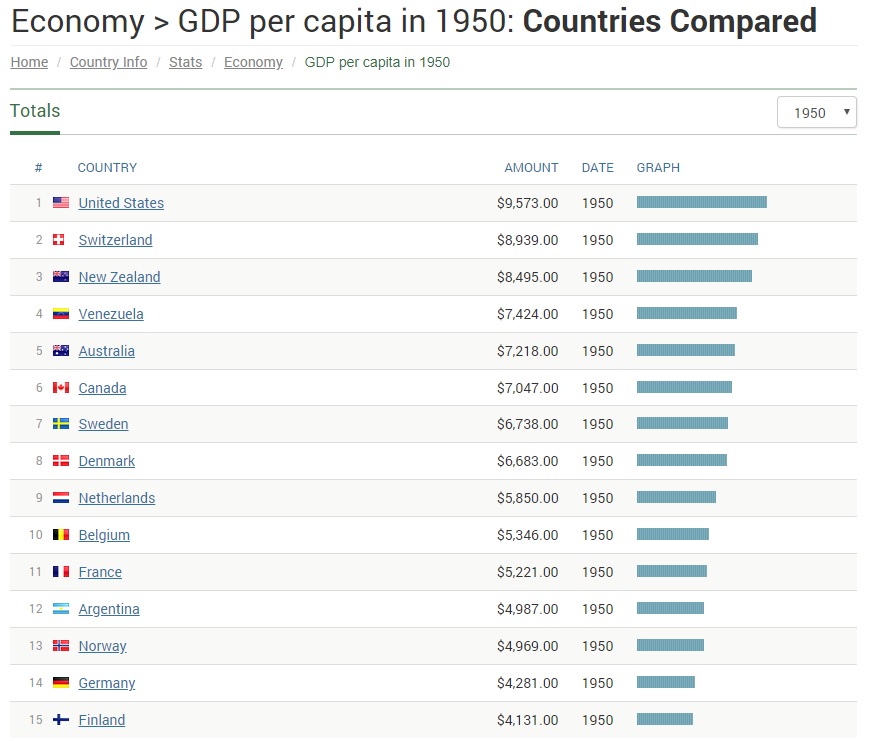
 Today, of course, Venezuela is ranked much lower. Decades of bad policy have led to decades of sub-par economic performance. And as Venezuela stagnated, other nations become richer.
 More than seven years ago, I pointed out that Argentina used to be one of the world’s richest nations, ranking as high as #10 in the 1930s and 1940s (see chart to right).

