Welcome to El Salvador, where the pupusas are warm and the bitcoin is tender.
Today, the Central American nation will become the first sovereign state to make bitcoin “legal tender,” meaning it’s now an official currency alongside the US dollar. In theory, El Salvadorans can now pay for anything—a haircut, house, or even taxes—using bitcoin.
The initiative is the brainchild of President Nayib Bukele, a 40-year-old populist whose approval rating of around 90% has emboldened him to reshape the country in his vision.
Why do this?
One-quarter of El Salvador’s GDP comes from remittances—money sent back to the country from people working abroad. Bitcoin could reduce fees on those cross-border transactions.
It’s an attempt to bring more Salvarodans into the economic fold, the majority of whom don’t have a bank account.
Bukele also thinks that, by being an early adopter, the country could become a destination for foreign investment in bitcoin mining. He wants to use geothermal energy from El Salvador’s volcanoes to power the energy-intensive mining process.
Like all experiments, this one could backfire
Despite all the buzz around crypto, bitcoin hasn’t been used as an actual currency at scale before. As a business, it’s important to accept payment in currency that won’t plummet in value in the future. Bitcoin, however, has been known to be extremely volatile.
And because bitcoin by definition skirts traditional financial institutions that promote stability, the International Monetary Fund is concerned that El Salvador’s adoption of the crypto could create serious risks for the country’s economy. As a result, it downgraded El Salvador’s debt further into junk territory.
Other critics say the bitcoin move is a PR play to distract from Bukele’s increasingly authoritarian tactics. After his recent calls to “purge” the government’s judicial branch, his allies recently passed a law to remove one-third of the country’s judges and prosecutors.
Bottom line: However this shakes out (and no one knows how it will), expect a lot of “I told you so”s from both sides of the debate. — NF
Facebook is ready to launch Novi, its digital wallet, exec David Marcus wrote in a memo Wednesday. He spearheads Diem (née Libra), the Facebook crypto project that kicked off with very grand ambitions.
Considering those initial ambitions, wallets may seem like a meek starting point for Diem. But wallets underpin everything. They’re indispensable for participation in any part of the cryptocurrency ecosystem, from storing your digital gold in a metaphorical vault to actively minting JPEG images as non-fungible tokens (NFTs).
What is a crypto wallet?
Wallets don’t “hold” your crypto so much as store the digital credentials required to access your coins. Your wallet is encrypted proof of ownership, consisting of your public and private keys (long, random alphanumeric strings of characters). Pro tip: Do not ever give away your private key, even if a scammer asks you nicely in the DMs.
Robust security is everything in cryptoland. Were thieves to gain access to your wallet and siphon away your funds, there’s no centralized intermediary who could roll back the on-chain transaction.
How to protecc, avoid attacc?
From whales to decentralization idealists, many opt for “cold storage” of their keys on hardware wallets. The physical devices allow for safekeeping that’s neither 1) paper nor 2) a hackable, online storage system.
While hot (internet-connected) wallets are less secure, they still have advantages, like letting traders move funds more freely. There’s a slew of desktop, browser, and mobile offerings in this category, like MetaMask, Coinbase Wallet, and Exodus.
In a trustless world…
...security and counterparty risks are the sine qua non of digital asset management.
And while self-custody will remain a key criteria for much of the crypto community, tens of millions of crypto users don’t hold their own keys, instead trusting centralized exchanges to safeguard their credentials. As digital assets move beyond crypto-native dev communities to Fortune 500s and rising fintechs, third-party custody isn’t going away.
Ultimately, it’s a choice that comes down to personal preferences, risk tolerance, and use cases.
You're interested in the world of crypto, but it feels impossible to know where to start. And that's normal—the number of options and recommendations can be incredibly overwhelming.
Want to explore these newfangled currencies running around the internet...but not sure where to start? We’ve got the answer: start with eToro.
Right now, if you buy $1,000 worth of crypto on eToro, you’ll get $50 smackeroos. That’s a nice swordfish dinner, just for getting into crypto on eToro.
Now that we’ve furnished proof of a medium-rare cut, let’s transition to the world of digital assets and talk about proof-of-stake, the next security foundation for Ethereum. The blockchain will complete its migration to PoS in thecoming months, the Ethereum Foundation said yesterday.
Ethereum is the clear platform of choice for Web 3.0. Created in 2015, the Ethereum blockchain has emerged as a globally distributed computing layer for all manner of decentralized applications, from financial services to one-of-a-kind tokens.
Ether, the cryptocurrency that powers Ethereum, is up 255% this year (but down 25% over the last 24 hours). It’s the second largest crypto by market value after bitcoin.
But with $ETH’s uptick in adoption comes growing pains. The network is more congested than the highways of Los Angeles, as decentralized apps and services sap capacity.
Here’s what proof-of-stake means and how it can help solve Ethereum’s congestion issues...and then some.
Before diving in, let’s cover the basics basics
What proof-of-stake is: A consensus mechanism
What's that? An algorithm that keeps blockchains—distributed networks of nodes—humming
What’s the status quo? Bitcoin’s blockchain uses proof-of-work (PoW), and so does Eth 1.0.
PoW requires mining, a computationally (and therefore energy) intensive process of solving complex cryptographic puzzles. “Ethereum will use at least ~99.95% less energy post merge,” its foundation said yesterday.
So, how does it work?
Network participants “stake,” or put up, their ETH as validators to reach consensus on transactions and establish new blocks of the ledger. The cutoff to become an Ethereum validator is a cool 32 ETH (~$88,000). At random, the network tasks validators to create new blocks on the chain or ensure that others’ are legit. These nodes are paid ETH as a reward.
If your node isn’t available when called upon to validate, you could lose a portion of your staked ETH. If you try any funny business, your stake could be confiscated.
Drawbacks? The biggest is that PoS is more of an unknown quantity. There are smaller and newer cryptocurrencies, such as Cardano, that already use PoS. But PoW is the only model that has truly stood the test of time. Plus, migrating to PoS is no easy affair. The Ethereum developer community has delayed the transition, which is occurring in phases.
Bottom line: When Eth 2.0 finally rolls out in full—an event that is expected early next year—it will act as the largest proving ground yet for the PoS method.
A work by digital artist Mike Winkelmann, also known as Beeple, sold for more than $69M at Christie's auction house yesterday. The work was sold as an NFT—a non-fungible token—and marks a record amount in the spiraling crypto art craze. The sale price exceeds that of any work from artists like Frida Kahlo, Salvador Dalí, and others.
NFTs are conceptually similar to digital certificates of authenticity that are completely unique and can't be forged. Similar to cryptocurrencies like Bitcoin, NFTs rely on blockchain technology (see 101), which uses decentralized networks to verify legitimacy and ownership. Since digital art (and other digital assets) can often be easily duplicated, these characteristics are viewed as the future of the digital art market. Go deeper on NFTs here.
The spectacular sales price appears mostly due to the pioneering use of the technology. Before last fall, the most Winkelmann had ever sold a piece for was $100.
Coinbase filed yesterday to go public through a $1 billion direct listing on Nasdaq. Last week, The Block reported that Coinbase shares recently exchanged hands in the private markets at an implied valuation of $100 billion.
If that holds, it’s just shy of the record valuation for a US tech company going public (Facebook). If Coinbase tops FB’s $104 billion, it will take the record.
The nine-year-old cryptocurrency exchange’s S-1 filing is exactly what you’d expect from a nine-year-old cryptocurrency exchange. Satoshi Nakamoto scores a mention on the first page; Coinbase also says unmasking the pseudonymous creator(s) of bitcoin could harm its business. Finally, the remote-first company lists “address not applicable” as its headquarters.
By the numbers (data from end of Q4 ‘20)
The total value of crypto assets on Coinbase’s platform = 11.1% of the total market cap of crypto assets
$456 billion has been traded on Coinbase over its lifetime; $90 billion of assets are stored on the platform
Coinbase has 43 million verified users
Zoom out: We’ll leave you with this graph, which tells its own story.
While Elon Musk has moved crypto markets before with a single meme, yesterday he sent the price of bitcoin soaring the old-fashioned way: buying a truckload of it.
According to an SEC filing Monday, Tesla purchased $1.5 billion worth of bitcoin using its cash reserves. Tesla also announced it would accept payment for its products in bitcoin on a limited basis, becoming the first major automaker in the world to do so.
Musk's moves were the mentos to the cryptocurrency's Coca-Cola. The price of a single bitcoin gained as much as 15% on the day and briefly surpassed its record high of over $44,000.
Why did Tesla hop on the bitcoin train?
Despite being a company that has struggled with profitability, Tesla actually has over $19 billion in cash and cash equivalents sitting around. In its SEC filing, the company stated the move was to "further diversify and maximize returns on our cash." In other words, it was looking to put some of that $19 billion to good use and Elon felt that sinking 8% of it into bitcoin was the best way to do that.
Tesla isn't the first: Jack Dorsey's fintech Square made a $50 million investment in bitcoin last October, and business analytics platform Microstrategy has accumulated over $3 billion worth of bitcoin using its excess cash reserves.
Tesla is by far the biggest fish in the corporate world to embrace bitcoin, but Elon's move may not have been a huge surprise to his 46.2 million Twitter followers. Musk added #bitcoin to his bio a few weeks ago, tweets about crypto more than Tesla, and mentioned he was a supporter of bitcoin during a conversation on the social media platform Clubhouse last week.
Bottom line: Tesla's stock (+1.7%) hardly budged yesterday, a signal that Tesla's stamp of approval is a much bigger deal for crypto enthusiasts who have been advocating for widespread adoption than it is for the automaker's underlying business.
Today might be one of the biggest days of my life, and it will be impossible to explain why that is so unless you know at least a little bit about blockchain, dAPPS, cryptocurrencies, Ethereum, and the legal distinction between a Simple Agreement for Future Tokens (SAFT) and an ICO.
If those words look unfamiliar, one of the biggest technical revolutions the world has ever known is sneaking up on you. The folks in Silicon Valley – who live about three years in the future compared to the rest of the country – can’t stop talking about this topic. The smartest people in the Valley tell me blockchain will change nearly everything, and already is. It’s like “the Internet” before anyone had heard of the Internet. That’s how big it is.
One small example is that startups are raising funds by creating and selling their own digital “tokens” or “coins,” using blockchain technology, that serve as the payment mechanisms within their products. The tokens have an advantage over regular money in part because you can program simple rules for them using distributed apps, or dAPPS, to add function to your product. And blockchain brings its own set of advantages I’ll mention below.
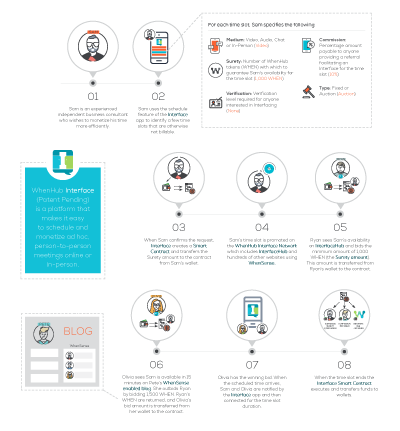
In the case of WhenHub, a dAPP will trigger an automatic payment when certain conditions are met. The effect is to eliminate billing and invoicing efforts for micro-contracts while creating a distributed record of each transaction that is impervious to manipulation.
My example doesn’t get at the full power of blockchain. It’s just one of the many things it can do.
The reason people buy these digital tokens from startups is that they hope the value will rise as the startup adds customers. The tokens are artificially limited in quantity, so the value of each token increases with demand. Customers of the startup won’t notice the rise in token value because prices within the product are pegged to nominal “real money” value. In other words, if one token is worth a dollar today, but worth ten dollars tomorrow, the startup auto-adjusts the price within the product to ten-percent of a token. The customer always pays the same “real money” price even as token values rise.
Tokens can easily be exchanged for Bitcoins or cash on websites that do that sort of thing. See Bitcoin Exchanges.
The process of creating digital tokens to raise funds is called an ICO (initial coin offering) when you do it the wild-west unregulated way. If you lawyer-up in advance, jumping through lots of (expensive) hoops to minimize future regulatory risks, your lawyers will tell you to call it a Simple Agreement for Future Tokens (SAFT). A SAFT is a contract with the startup to issue you tokens if and when it is able to launch a network in which the token has utility value. That’s what WhenHub is announcing today.
To be clear, ICOs and SAFTs are not investments, nor do they give the buyer equity in the startup. But they do provide an easy way – compared to angel investing – to share in whatever success the startup experiences. With SAFTs and ICOs the startup describes its plans in a white paper so any potential token buyers can evaluate the risks. WhenHub already has several products on the market, with more coming soon, but we describe in our white paper a proposed new product that is based on our existing scheduling platform and takes advantage of blockchain. The proposed product (WhenHub Interface) is the one that will use digital tokens.
If you are new to this field, I hope I just gave you a toe-hold for understanding it. And I would be delighted if you share this post with friends.
Our tokens are only available in Australia, Canada, European Economic Area, Hong Kong, India, Israel, Japan, Russian Federation, Switzerland, United Kingdom and United States (excluding New York State). If you are in the United States, you need to be an Accredited Investor (meaning kinda rich) to participate. Outside the United States, regulatory restrictions are lower.
Our Pre-sale is now in progress and our Public Sale starts on Nov. 10, 2017. During the Pre-sale, the minimum purchase amount is $50,000 and participants get an Early Bird bonus of 30%. For the Public Sale the minimum amount is $250, and the the Early Bird discount starts at 20% and decreases to none in two weeks.
Here’s the executive summary from our white paper. A link to the full paper is at the end.
— Executive Summary —
WhenHub proposes to build a mobile app for connecting consumers to experts of all kinds via two-way video streams, text, audio, or in person. The app will be part of a larger service ecosystem called the WhenHub Interface Network (WIN) (Patent Pending).
The service will use dAPPS (distributed apps) running on the Ethereum blockchain to create secure micro-contracts – that can be as short as 15 minutes – as well as to provide frictionless billing and payment service. At the end of each micro-contract, payment in the form of WHEN Tokens will be automatically transferred to the expert. No paperwork or billing is involved.
Users buy WHEN Tokens using a credit card or with Bitcoins at an online exchange via the WhenHub Interface app. The tokens are used within the app to pay experts for their time.
For privacy, your phone number and address are not shared with experts.
Our partners will provide verification services on participating experts to give consumers confidence.
No international billing and currency issues when WHEN Tokens are involved.
Pricing for experts can be fixed or auction-based.
In the gig economy, think of this product as a “long tail” market for expert advice. Experts of all kinds can display their availability whenever they like, for as short a window as 15 minutes.
The WhenHub Interface app will use the existing commercial WhenHub API for scheduling and geofencing features.
WhenSense is our proposed technology for allowing third-party sites to host ads about our participating experts’ availability and share in the income from completed contracts. Site owners paste our HTML code into their site to participate.
WHEN Tokens are not an investment vehicle, but because they will be artificially limited in quantity, their value is expected to fluctuate based on customer demand for the WhenHub Interface app.